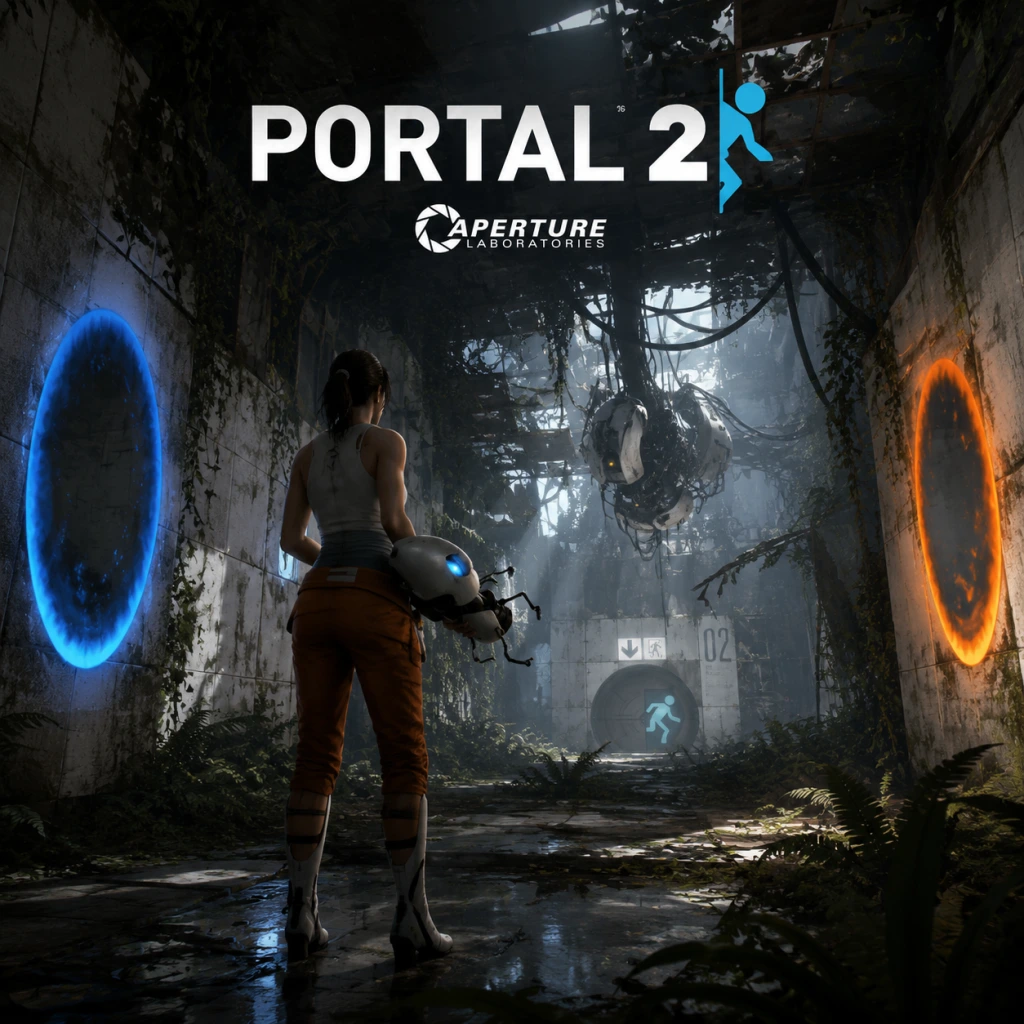
Game Introduction
Game Introduction: Portal 2
Genre
First-person puzzle-platformer with physics-based mechanics, dark comedy, and a narrative-driven campaign. It blends environmental puzzles, spatial reasoning, and a unique portal mechanic.
Developer & Publisher
- Developer: Valve Corporation (South Bellevue, Washington, USA)
- Publisher: Valve Corporation (digital), Electronic Arts (retail)
- Announcement: March 5, 2010 (via Game Informer)
- Release Date: April 19, 2011 (PC, Mac, Xbox 360, PlayStation 3)
- Linux version: February 27, 2014 (via SteamOS/Linux)
- Nintendo Switch (Portal: Companion Collection): June 28, 2022 (bundled with Portal 1)
- PC (Windows) – Steam
- Mac (OS X) – Steam (Universal binary)
- Linux – Steam (native)
- PlayStation 3 – Physical disc & PSN digital
- Xbox 360 – Physical disc & Xbox Live Arcade
- Nintendo Switch – Only as part of the Portal: Companion Collection
- Nvidia Shield TV (2015) – Android-based port
- Steam Deck – Verified playable (native)
- Overgrown Test Chambers – Moss-covered, broken rooms with malfunctioning equipment.
- Abandoned Maintenance Areas – Dark, rusty tunnels, rail systems, and generator rooms.
- Old Aperture (1950s–1980s) – Retro-futuristic sections with wood-paneled walls, dials, and analog computers, showcasing the company’s history.
- New Aperture (2000s) – Clean white tile labs, high-tech gel dispensers, and neural-interface testing.
- Central Core – The AI-mainframe room at the top of the facility.
- Chell – The silent, determined protagonist, a test subject wearing an orange jumpsuit and Aperture Science Long Fall Boots. Her history includes being adopted by GLaDOS’s early testing.
- GLaDOS (Genetic Lifeform and Disk Operating System) – The primary antagonist, a malevolent AI with a passive-aggressive personality. After being rebooted, she is initially weakened and later becomes more human-like (but still manipulative).
- Wheatley – A personality core (oblong, blue, with a British accent) designed to make poor decisions. He is initially helpful, turning into the main antagonist in the second half of the campaign. His incompetence becomes a deadly threat.
- Cave Johnson – The deceased founder/CEO of Aperture Science, heard only through pre-recorded 1950s–1980s-era audio logs. His rambling, energetic monologues provide crucial backstory and comic relief.
- ATLAS and P-body – The player characters in the cooperative campaign, two robots built by GLaDOS for testing. They are silent but express emotions through lights and sounds.
- Ingenious Puzzle Design – Every test chamber is a perfectly crafted spatial challenge requiring creative use of portals, momentum, light bridges, lasers, and gels.
- Unmatched Writing & Voice Acting – Dialogue by Garrick (Wheatley), Ellen McLain (GLaDOS), and J.K. Simmons (Cave Johnson) is brilliant, hilarious, and iconic.
- Physics Sandbox – The portal gun allows endless experimentation; momentum conservation via portals creates a satisfying sense of flow.
- Emotional Depth – GLaDOS’s arc from villain to reluctant ally, and Cave Johnson’s tragic humanist narrative, attach real feelings to the machines.
- Replayability – Hidden chambers, developer commentary, and user-created maps via Steam Workshop extend the experience indefinitely.
- Puzzle Enthusiasts – Players who enjoy logic, spatial reasoning, and trial-and-error solutions.
- Fans of Dark Comedy – The game's humor appeals to those who appreciate witty, sarcastic, and absurd writing.
- Story-driven Gamers – A compelling narrative with well-developed characters and lore.
- Speedrunners – The game’s physics and timer encourage competitive runs.
- Cooperative Gamers – The two-player campaign is designed for teamwork, communication, and coordination.
- All Ages (13+) – No explicit violence or gore, but some dark themes and mild language; suitable for teenagers and up.
- Single-Player Campaign – A 6–8 hour story mode of ~19 test chambers plus interstitials. The player uses portals, gels (Repulsion, Propulsion, Conversion), light bridges, and excursion funnels.
- Cooperative Campaign – A separate 5–7 hour campaign (21 chambers) designed for two players (local split-screen or online). Each player controls a robot (ATLAS or P-body) with dual-portal guns. Puzzles require synchronized actions, ping tools, and non-verbal communication.
- Challenge Mode – Replay single-player chambers with time-based, step-based, or portal-limited scoring.
- Steam Workshop – User-created maps (PC/Mac/Linux only) with infinite custom puzzles, many of high quality.
- Perpetual Testing Initiative (free DLC) – A campaign of five community-made test chambers that can be played in single or co-op.
- Offline – The full single-player campaign and local co-op (split-screen on consoles; same-screen on PC via peripherals) are playable without internet.
- Online – Co-op requires a Steam account and internet connection for matchmaking or friend invites. PS3 version supports cross-platform co-op with PC (via Steam login). Leaderboards and Steam Workshop require connectivity.
- No Online-only Requirements – The game has no DRM beyond Steam (PC) or console account requirements; DRM-free version not available.
- Portal 2: The Final Hours – A free interactive book/DLC on Steam that provides behind-the-scenes commentary and mini-games.
- Perpetual Testing Initiative – Free DLC (released May 8, 2012) adding a set of five single-player and co-op test chambers created by community members. Also introduced the map-editing kit (Hammer) and Steam Workshop integration.
- Portal 2: The Original Soundtrack – Available as paid DLC on Steam (MP3/FLAC).
- No Major Paid Expansions – No story-based expansions exist. The game’s longevity comes from user-generated content.
- Portal Gun as Only Tool – Unlike most FPS games, the player has no weapons; only the portal gun, which creates two linked portals on certain surfaces. This simple mechanic yields infinite complexity.
- Physics-Based Momentum – The preservation of momentum through portals (e.g., falling into a portal and exiting with high speed) is a foundational puzzle element that feels incredibly rewarding.
- Narrative as Game Mechanic – The story unfolds through environmental puzzles, audio logs, and dialogue that directly integrates with gameplay. The infamous “The cake is a lie” meme originated here.
- GLaDOS’s Voice as Opponent – The AI’s sarcastic, passive-aggressive comments create a unique antagonist that players both love and resent.
- Full Bot Personality – Wheatley’s evolution from friendly helper to megalomaniacal villain is compelling and tragic.
- Co-op as True Collaboration – The co-op campaign is not just single-player with two characters; it’s designed around teamwork, with puzzles that specifically require two players to solve together using ping tools and timing.
- Cultural Impact – Portal 2 is widely considered one of the greatest games of all time, praised for its writing, innovation, and perfect balancing of challenge and humor. It remains a benchmark for puzzle game design.
Release Timeline
Platforms
Note: The PlayStation 3 version includes unique cross-platform play with Steam (via Steam Cloud saves and cross-play with PC users).
Story Overview
Set an undetermined amount of time after the events of the first Portal, the player awakens as Chell in the Aperture Science Enrichment Center, which has fallen into extreme disrepair. The facility's automated systems have malfunctioned, and the eccentric personality core Wheatley wakes Chell with the goal of escaping. Together they navigate crumbling test chambers and maintenance areas, but Wheatley's well-meaning incompetence leads to the revival of GLaDOS, the once-defeated AI. GLaDOS is furious and resumes testing, forcing Chell into a new series of puzzles. The story deepens as Chell explores the origins of Aperture Science, the fate of its former CEO Cave Johnson, and the ultimate nature of GLaDOS. A climactic betrayal by Wheatley, who seizes control of the facility, leads to a final confrontation that determines the fate of both AI and the human protagonist.
Setting
The entirety of Portal 2 takes place within the vast, decaying ruins of the Aperture Science Innovators facility, located underground in Upper Michigan, USA. Environments include:
The world is half-destroyed, atmospheric, and full of environmental storytelling through graffiti, audio logs, and visual decay.