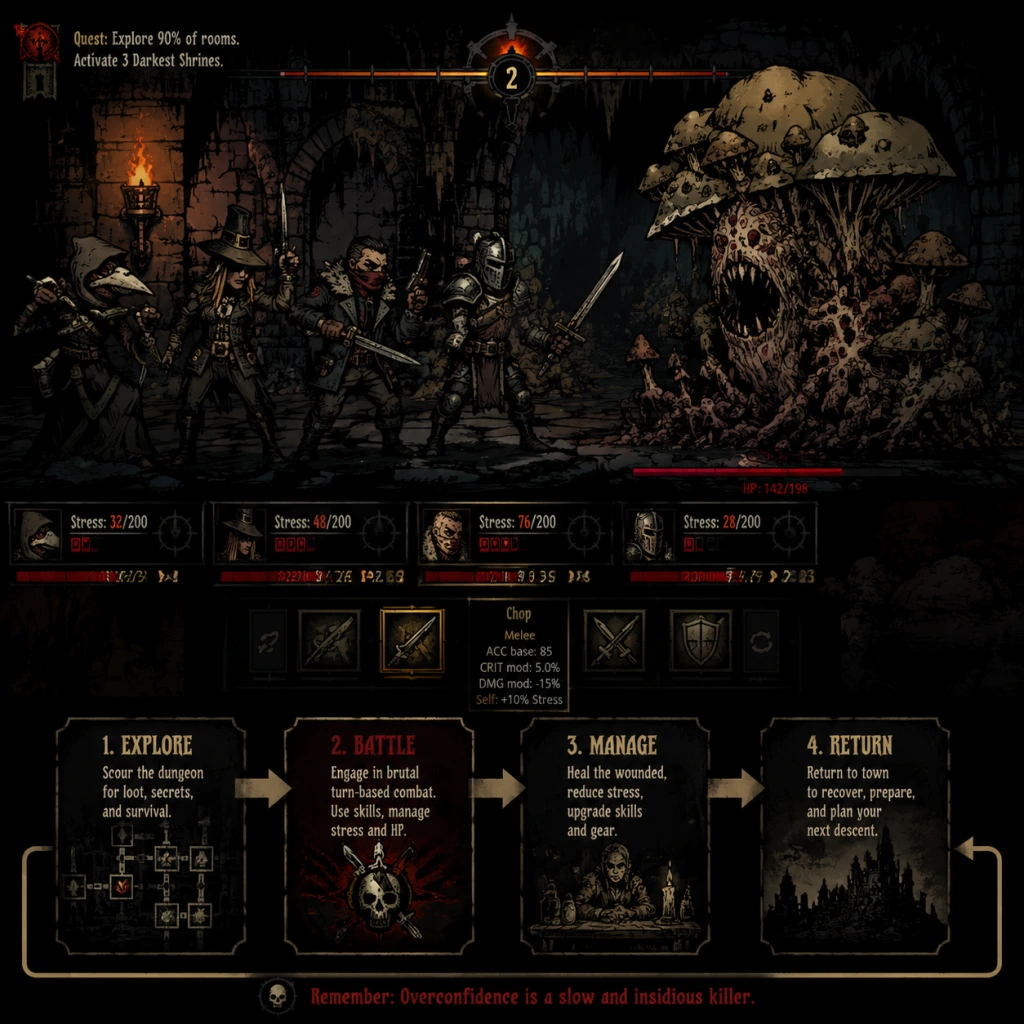
Core Gameplay
Core Gameplay Guide for Darkest Dungeon
Overview of the Core Gameplay Loop
Darkest Dungeon’s core loop revolves around managing a roster of heroes as they explore procedurally generated dungeons, fight eldritch horrors, and attempt to cleanse the estate of the Ancestor’s sins. Each run follows this structure:
1. Recruit new heroes from the Stagecoach (Hamlet).
2. Equip them with skills, weapons, armor, and trinkets.
3. Select a quest from the map (location, length, difficulty).
4. Provision with supplies (food, torches, shovels, etc.).
5. Explore the dungeon: navigate corridors, interact with curios, fight battles, manage stress and health.
6. Complete the quest objective (e.g., kill a boss, collect loot).
7. Return to the Hamlet, treat diseases and stress, upgrade town buildings, and repeat.
Every expedition affects your heroes’ mental and physical state—failure or reckless play can cripple your roster permanently.
Combat System
Turn-Based Positional Combat
- Heroes and enemies occupy positions 1–4 (front to back).
- Each skill has a range requirement (e.g., “Ranged: 1–2” means it can hit enemies in positions 1 or 2).
- Move skills can shift positions (e.g., Pull, Push, Move Forward/Back).
- Order of actions determined by Speed stat (higher goes first).
- Stress is a second health bar. At 100 stress, hero has a stress check:
- Stress is reduced via camping skills, certain trinkets, and critical hits.
- When HP reaches 0, hero enters Death’s Door. Any further damage can kill them (chance based on Deathblow Resist).
- Healing a Death’s Door hero above 0 brings them back to normal.
- Each hero performs one action per turn (use skill, move, guard, etc.). Some skills have stun, blind, etc.
- Overconfidence is a slow and insidious killer. Plan ahead.
- Torch light (0–100) affects combat stats (accuracy, dodge, crit) and dungeon events (scouting, surprise).
- Low light increases loot but also monster spawns and trap damage.
- Radiant Light (75+): easier fights, better scouting, less stress.
- Darkness (0–25): harder fights, more loot, stress gain, and chance for Shambler encounter (very dangerous).
- Interact with objects in dungeons (books, plants, coffins, etc.) to get rewards or consequences.
- Many curios require a provision item for best outcome:
- Empty bottles, shovels, keys, and herbs also serve specific interactions.
- Scouting reveals the map, hidden rooms, traps, and enemy patrols.
- Traps (e.g., tripwires, pressure plates) can be disarmed by heroes with high Trap Disarm stat (usually Houndmaster, Plague Doctor). Failure causes damage/stress.
- Only in medium/long dungeons. Spend time to rest, eat, use camping skills.
- Skills provide buffs, stress reduction, health recovery, cure diseases, etc.
- Example: The Leper’s Solemnity (self-heal) or Jester’s Harvest (stress heal party).
- Room Battle: Clear all monsters in a specific number of rooms.
- Scout: Explore a percentage of tiles.
- Collect: Gather a number of items (e.g., 3 Gems).
- Boss: Defeat a region boss (e.g., Necromancer, Hag, Swine King).
- Activate: Interact with objects (e.g., Vvulf’s beacon).
- Apprentice (green): Levels 0–2 heroes.
- Veteran (yellow): Levels 3–4 heroes.
- Champion (red): Levels 5–6 heroes.
- Darkest Dungeon (purple): Special final missions, level 6 heroes only.
- Quests reward gold, heirlooms (for upgrades), trinkets, and resolve XP.
- Additional loot from clearing rooms and bosses.
- Primary currency for provisions, hiring heroes, upgrading, and removing negative quirks.
- Obtain from quest rewards, selling loot, and trinket salvage.
- Four types: Busts, Portraits, Deeds, and Crests.
- Used to upgrade town buildings:
- Equippable items that boost stats or grant special effects.
- Rarity: Common (white), Uncommon (green), Rare (blue), Very Rare (orange), Ancestral (purple), and Crimson Court DLC trinkets.
- Example: Junia’s Head (+30% heal received, -20% stress heal) is powerful but risky.
- 15 base classes (plus 3 DLC classes). Each has unique skills, stats, and role.
- Examples:
- Heroes gain XP from quests to increase resolve level (0–6).
- Max level 6 is required for Darkest Dungeon missions.
- Higher levels unlock better weapons/armor/skills but also face harder dungeons.
- Unlock skills in Guild (up to 4 per hero). Choose 4 for each mission.
- Builds revolve around synergy: e.g., Mark team (Arbalest, Houndmaster, Bounty Hunter, Occultist).
- Example of good early build: Plague Doctor with Blinding Gas (stun back rows) and Noxious Blast (blight).
- Heroes gain quirks (positive/negative) from experiences.
- Remove bad quirks at Sanitarium (costs gold).
- Diseases must be treated or can be cured via camping or combat.
- Example: The Kleptomania quirk causes hero to steal loot; Fearful lowers resistance.
- Heroes who die are gone permanently (except in certain retreat options).
- Recruit replacements from Stagecoach; starting at low levels is normal.
- Never get attached to a single hero; build a deep bench.
- Unlock all classes by upgrading Stagecoach.
- Build a roster of 8–12 heroes at resolve level 0–2.
- Upgrade Stagecoach and Guild/Blacksmith first.
- Farm gold and heirlooms in green (Apprentice) dungeons.
- Complete first boss (e.g., Necromancer in Ruins) to unlock next tier.
- Vestal + Highwayman + Crusader + Plague Doctor (balanced).
- Use stuns and stress heals generously.
- Promote heroes to resolve 3–4.
- Tackle Veteran dungeons (yellow).
- Clear all region bosses (Necromancer, Swine Prince, Hag, Siren, Crew, Prophet, Brigand Pounder, etc.).
- Upgrade Blacksmith and Guild to rank 3–4.
- Acquire rare trinkets from bosses and quests.
- Reach champion level (5–6) heroes.
- Complete all champion dungeon quests for best trinkets.
- Take on Darkest Dungeon quests (first three locations: Weald, Warrens, Ruins).
- Manage negative quirks aggressively; remove locking bad ones.
- Enemies have high PROT and deadly specials (e.g., Wilbur’s Mark from Swine King).
- Use heroes with high accuracy (e.g., Houndmaster with Accuracy trinkets).
- Bring stun resist and bleed resist.
- First quest (DD1) requires high scouting and stress heal (Jester or Houndmaster).
- Team example: Vestal, Houndmaster, Highwayman, Man-at-Arms (for guard and riposte).
- Bring maximum torches, food, and bandages.
- Complete the final boss (The Heart of Darkness).
- Survive the final assault (DD4 team may die permanently).
- Achieve ending (good/bad based on hero count).
- Unlock Stygian/Bloodmoon mode (NG+ with time limit and death limits).
- Try challenge runs (e.g., no torch, single class, etc.).
- New Game Plus (Stygian) raises difficulty: 100 weeks, max 13 deaths, boss must be killed by week 100.
- Complete remaining achievements.
- Experiment with odd team comps.
Stress and Afflictions/Virtues
- Affliction (bad): e.g., Hopeless, Fearful, Selfish, etc. Reduces performance and may cause negative actions.
- Virtue (rare, good): e.g., Stalwart, Focused, Courageous. Grants powerful buffs.
Death’s Door
Action Economy
Exploration & Interaction
The Light System
Curios and Supplies
- Example: In the Ruins, use Holy Water on an Eldritch Altar to gain positive quirk and loot; use nothing to take stress and disease.
Scouting and Traps
Camping
Quests & Missions
Quest Types
Difficulty Levels
Rewards
Economy & Hamlet Upgrades
Gold
Heirlooms
- Stagecoach: More heroes per week, higher level recruits.
- Blacksmith: Upgrade weapon/armor tiers.
- Guild: Unlock and upgrade skill ranks.
- Sanitarium: Remove quirks, treat diseases.
- Abbey & Tavern: Stress relief facilities.
- Survivalist: Camping skills and provisions.
- Nomad Wagon: Buy trinkets.
Trinkets
Character & Build Growth
Hero Classes
- Vestal: Healer, frontline support.
- Highwayman: Versatile damage, riposte.
- Leper: High damage, self-sufficient, poor accuracy.
- Jester: Stress healer, bleed specialist.
- Plague Doctor: Blight, stun, cure diseases.
Resolve Levels
Skills and Builds
Quirks and Diseases
Death and Roster Management
Progression Tiers
Early Game (Weeks 1–15)
Goals:
Effective Dungeons: Ruins and Warrens are forgiving. Weald has blight, Cove has high prot enemies.
Team Compositions:
Important Upgrades: Stagecoach (more recruits per week), Blacksmith (weapon/armor rank 1–2), Guild (skill ranks).
Pitfalls: Overconfidence leads to losing heroes. Always bring at least 4 food, 8 torch, 2 shovels per medium mission. Stress management is key.
Mid Game (Weeks 15–40)
Goals:
Changes: Enemies hit harder, have more HP, and inflict higher stress. Prioritize trinkets that mitigate stress or boost accuracy.
Team Synergies: Build around marks, stuns, or bleed/blight. Example: Arbalest (heal/mark) + Houndmaster (bleed/dog treats) + Bounty Hunter (pull/stun) + Occultist (heal/mark).
Camping Skills: Unlock Scout Ahead, Wound Care, and stress reduction skills.
Caution: Veteran dungeons are deadly without proper equipment. Level up weapons and armor before going.
Late Game (Weeks 40–70)
Goals:
Champion Dungeon Tactics:
Trinket Farming: Farm Shambler (in low light) for Ancestral trinkets. Kill Brigand Vvulf for Vvulf’s Tassett.
Darkest Dungeon Preparation:
Endgame (After DD4)
Goals:
Post-Game:
Final Boss Tips: The Heart of Darkness is a marathon. Bring heavy stress heal, high HP, and strong single-target damage. Each DD mission permanently removes heroes (they cannot be used again).
Conclusion
Mastering Darkest Dungeon requires understanding resource management, stress mitigation, and strategic team building. The game punishes overconfident play – respect every enemy, prepare for every expedition, and always have a backup plan. Remember: Remind yourself that overconfidence is a slow and insidious killer.