Core Gameplay
Overview of Core Gameplay Loop
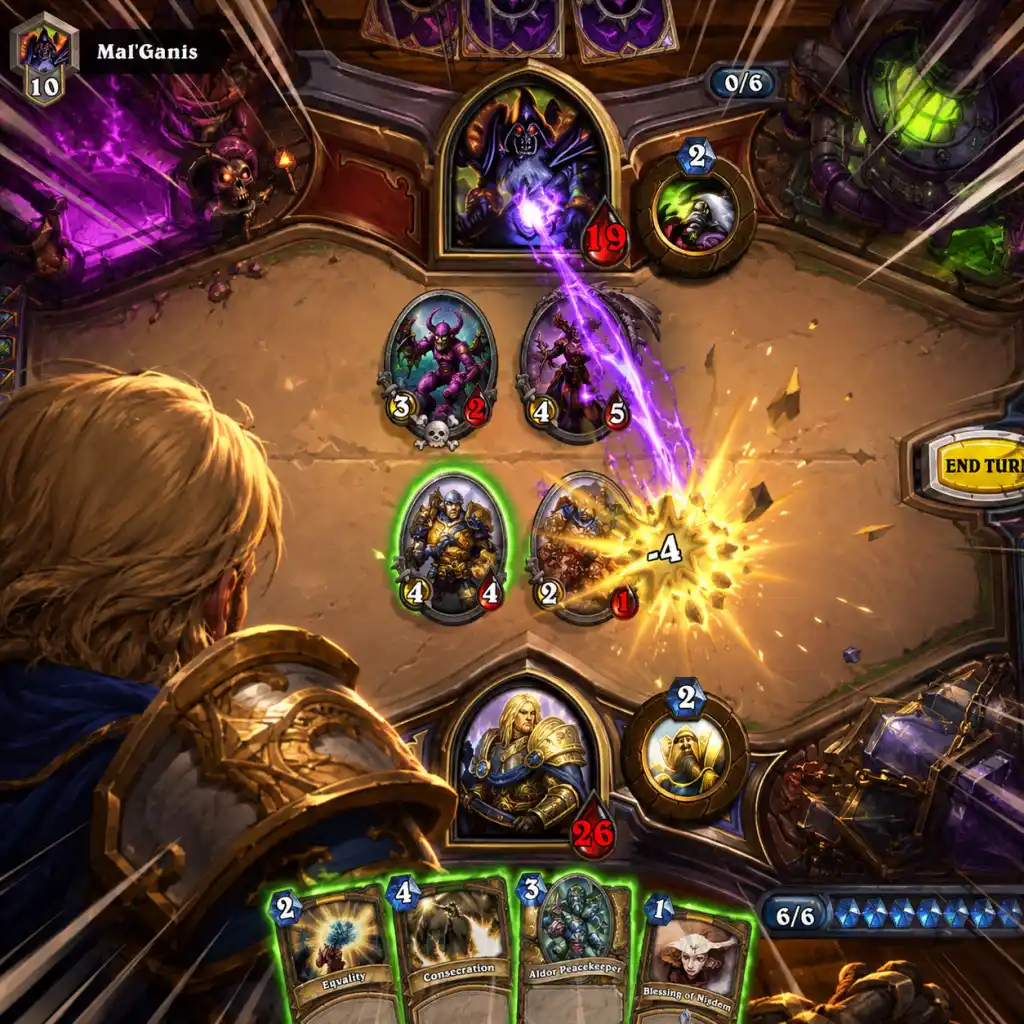
Hearthstone is a turn-based digital card game where two players face off using pre-constructed decks of 30 cards. The primary loop is: Draw a card → Play cards using mana crystals → Attack enemy minions or the opposing hero → End turn until one hero’s health reaches 0. You can customize your deck with cards from your collection, earned through packs, crafting, or rewards. The game features several modes, each with its own rules and progression, but the core loop remains consistent across all constructed modes.
Core Systems
- Mana System: Each turn you gain one mana crystal (up to 10 total). You spend mana to play cards. Cards have a cost (0-10) and effects (summon minions, deal damage, draw cards, etc.).
- Combat: Minions attack enemies each turn after being played. They can attack enemy minions or the enemy hero. Damage reduces health; minions die when health hits 0.
- Hero Powers: Each class has a unique 2-cost hero power (e.g., Mage deals 1 damage, Priest heals 2). These can be used once per turn.
- Quests and Missions: Daily and weekly quests reward gold, XP, and sometimes packs. The Rewards Track gives cosmetics and resources as you level up.
- Progression: Player levels (1-60+) earn classic packs and dust. Ranked mode uses medals (Bronze → Diamond → Legend). Battlegrounds and Arena have separate rating systems.
- Economy: Gold is earned from quests and wins (up to 100 gold per day from 3 wins). Packs cost 100 gold. Arcane Dust is used to craft specific cards. Disenchanting cards yields dust.
- Build Growth: Collecting cards expands your arsenal. Crafting key cards for meta decks accelerates competitiveness. Legendary cards are powerful but require 1600 dust each.
- What to Expect: You begin with a handful of basic cards for each class. You’ll face other new players or AI in Apprentice Ranks. Progress through 40 ranks (Apprentice 40 to 1) by winning games. You cannot lose ranks here, making it a safe learning zone.
- Deck Building: Stick to one class and craft cheap neutrals (e.g., Chillwind Yeti, Bloodfen Raptor). Use class-specific basic cards. Example: Mage with Frostbolt, Fireball, and cheap minions is effective.
- Economy Focus: Complete all daily quests (reroll 50-gold quests for 60+). Save gold for 10-pack bundles of the latest expansion to guarantee a legendary in the first 10 packs.
- Quests and Rewards: The Apprentice Track gives 30+ packs and a guaranteed legendary (Arfus? Actually, the reward is a specific class legendary—e.g., Zayle, Shadow Cloak? No, the guaranteed legendary from early packs is random but one of the first 10 packs in a set. The Apprentice Track also awards a free Death Knight? Actually, the new player experience gives a free deck of choice after completing Apprentice ranks. Choose a deck from a meta tier list (e.g., Irondeep Trogg Beast Hunter or Whizbang? Check current standard).
- Progression Tips: Focus on Standard format (rotating expansions). Avoid crafting Wild-format cards early. Use the in-game deck recipes as starting points. Learn to trade efficiently (attack with your minion into a larger minion to kill it without losing yours).
- What to Expect: Ranking up now involves wins and losses (stars). You start at Bronze 10 and progress through Silver, Gold, Platinum, Diamond, with bonus stars for win streaks. Reaching Diamond 5 resets to Bronze 10 each month (but you keep the highest rank reward).
- Deck Building: You should have enough cards for at least one tier-1 or tier-2 deck. Focus on a single powerful deck (e.g., Aggro Demon Hunter, Control Warrior, or Token Druid). Craft essential legendaries (e.g., Kael’thas Sunstrider? Actually, good early legendaries: The Leeroy Jenkins for aggro, or Alexstrasza for control).
- Economy Focus: Complete weekly Tavern Brawl for free pack. Save gold for the mini-set (2000 gold) or use in Arena if you enjoy it. Disenchant extra copies and golden cards you don’t need. Prioritize crafting cards for your chosen deck over collecting all cards.
- Quests and Rewards: Daily quests now give 60–100 gold. Weekly quests (e.g., play 20 games) reward 2500 XP for the Rewards Track. Track levels grant packs, gold, and cosmetics. Aim for level 50 on the Track to get all major rewards.
- Progression Tips: Learn matchup knowledge. For example, as an aggro player, race to kill control before they stabilize. Use deck trackers (e.g., Hearthstone Deck Tracker) to improve decision-making. Manage your mana curve (average cost 2–3 for aggro, 3–4 for control).
- Arena and Tavern Brawl: Arena is a good place to earn packs and gold if you average 4+ wins. Tavern Brawl offers weekly fun and a free pack for first win.
- What to Expect: Diamond 5 to Legend is the most competitive climb. No win streak bonuses, so each game matters. You need a ~55%+ win rate to progress. Only the top ~1% of players reach Legend each month.
- Deck Building: You must play a refined, high-tier deck. Common choices: Quest Mage, Handbuff Paladin, or Control Warlock. You should have all essential cards, including multiple legendaries. Tech choices matter (e.g., include Gift of the Wild against aggro, or Theotar, the Mad Duke for disruption).
- Economy Focus: At this stage, you probably have a large collection. Save gold for upcoming expansions. Use duplicate protection to avoid opening extra legendaries. Prioritize crafting key neutrals like “Gigafin” or “Lord Barov”.
- Quests and Rewards: Rewards Track still provides XP and gold. The Legend rank rewards a special card back and a Legendary card (random) at season end.
- Progression Tips: Play multiple games with the same deck to master it. Learn to read opponent’s hand (e.g., Druid holding 2 cards might have Bloom or Survival of the Fittest). Use resources like HSReplay.net to see deck win rates. Adjust tech cards based on pocket meta (common decks you face).
- Mental Game: Avoid tilt. Take breaks after losses. Focus on making the optimal play each turn, not just big swings.
- What to Expect: Once at Legend, you compete for top 1000 or even top 100 (shown by a number). Win streaks matter again. Toxic environment may exist. Top players stream or enter qualifiers for tournaments (e.g., Hearthstone World Championship).
- Deck Building: Experiment with off-meta decks to counter the Legend meta. Control and combo decks often dominate. Example: “Thief Rogue” or “Miracle Priest” can catch opponents off guard.
- Economy Focus: Gold is abundant if you consistently earn from quests. Focus on collecting full expansion sets. Use gold to buy bundles or enter high-stakes modes like Heroic Brawliseum (12-win challenge).
- Quests and Rewards: At Legend, the Rewards Track maxes out at level 400+? Actually, after level 50, you earn cosmetic rewards every level. No additional functional rewards.
- Exploration and Variety: Try all modes:
- Competitive Play: Qualify for Masters Tour via top Legend finishes or special qualifier tournaments. Practice with scrims and study replays.
- Progression Tips: Analyze your gameplay with replays. Focus on mulligan decisions (keeping the right 3 cards). Learn to play around opponent’s AOEs. For example, against Control Warlock, keep minions above 1 health to avoid Defile.
Progression Tiers in Hearthstone
Early Game (Levels 1–20, Apprentice Ranks)
Objective: Learn basic mechanics, earn core cards, and build your first functional deck.
Example: A new player chooses Mage. Basic deck includes Frostbolt (3 cost deal 3), Fireball (4 cost deal 6), and minions like Novice Engineer (2 cost draw a card). They grind Apprentice ranks, earning packs and gold. After reaching Apprentice 1, they receive a free deck (e.g., a budget Druid ramp deck). They then pick Druid and start climbing Bronze.
Mid Game (Level 20–50, Bronze through Diamond Ranks)
Objective: Refine deck knowledge, climb ladder, and acquire a competitive deck.
Example: A player has a budget Face Hunter deck (low-cost minions and spells). They climb from Bronze to Gold by maintaining a positive win rate. At Gold 5, they craft the legendary “Krul”? Not. Actually, “Luna’s Pocket Galaxy” for mage? Better example: The player saves 1600 dust for “The Queen’s Guard” (a neutral legendary). They improve their deck’s consistency and push to Platinum.
Late Game (Diamond 5 to Legend)
Objective: Reach Legend rank, optimize gameplay, and fine-tune deck choices.
Example: A player reaches Diamond 2 with a Secret Paladin deck. They notice many Druids. They swap one secret for a “Divine Favor” to disrupt Druid ramp. They push to Legend with a 58% win rate over 200 games.
Endgame (Legend rank, High MMR, Competitive Modes)
Objective: Sustain high Legend rank, compete in events, or excel in other modes like Battlegrounds and Arena.
- Battlegrounds: Autobattler mode. Progress here with rating (up to 18,000+). Requires knowledge of tribes, triples, and economy management.
- Arena: Draft a deck and aim for 12 wins. Target 7+ wins to go infinite. Draft tier lists and meta knowledge are key.
- Duels: Construct a 15-card deck then draft cards between matches. Similar to Arena but with hero powers and treasures.
- Tavern Brawl: Weeklies often have unique rules.
Example: A top Legend player (rank 357) plays a homebrew Big Priest in Wild format. They reach top 50 by predicting the meta shift. They then qualify for a Blizzard tournament by finishing top 4 in a qualifier. They also maintain high MMR in Battlegrounds (12,000 rating) by mastering the Elemental tribe.