Game Introduction
Game Introduction
Genre and Developer
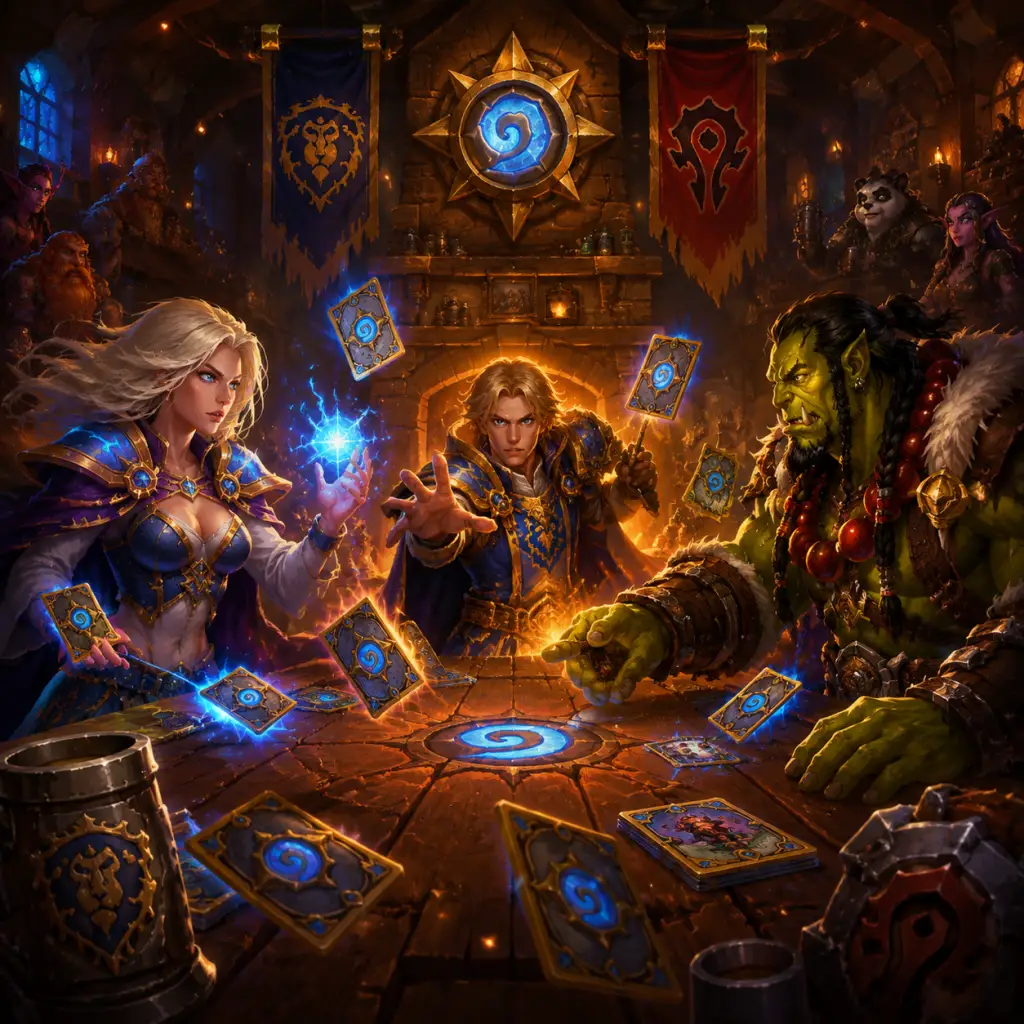
Hearthstone is a digital collectible card game (CCG) developed and published by Blizzard Entertainment, the renowned studio behind World of Warcraft, Overwatch, and Diablo. It blends strategic deck-building with turn-based card combat, wrapped in the high-fantasy world of the Warcraft universe.
Release Timeline and Platforms
- Initial Announcement: March 2013 (PAX East)
- Open Beta: January 21, 2014 (Windows, Mac)
- Full Launch: March 11, 2014 (Windows, Mac)
- iPad: April 16, 2014
- iPhone & Android: August 2014 (tablets), December 2014 (phones)
- Cross-Platform Play: Available from launch on all platforms.
- Windows PC
- macOS
- iOS (iPhone, iPad)
- Android (phones, tablets)
- Mage – Jaina Proudmoore (hero power: Fireblast)
- Paladin – Uther Lightbringer (hero power: Reinforce)
- Hunter – Alleria Windrunner / Rexxar (hero power: Steady Shot)
- Rogue – Valeera Sanguinar (hero power: Dagger Mastery)
- Warlock – Gul’dan (hero power: Life Tap)
- Druid – Malfurion Stormrage (hero power: Shapeshift)
- Shaman – Thrall (hero power: Totemic Call)
- Warrior – Garrosh Hellscream (hero power: Armor Up!)
- Priest – Anduin Wrynn (hero power: Lesser Heal)
- Demon Hunter – Illidan Stormrage (hero power: Demon Claws; added with Ashes of Outland)
- Death Knight – The Lich King (hero power: Ghoul Charge; a separate class added in March of the Lich King, with its own set and hero power)
- Casual players who enjoy quick, fun card games with a gentle learning curve.
- Competitive players seeking strategic depth and a ranked ladder.
- Card-collection enthusiasts (similar to Magic: The Gathering or Yu-Gi-Oh!) but digital-only.
- Warcraft lore fans who appreciate familiar characters and humor.
- Mobile gamers looking for a polished, free-to-play CCG.
- Casual Mode: Unranked matches against other players.
- Ranked Mode: Competitive ladder with monthly seasons and rank rewards (Bronze to Legend).
- Arena: Draft mode where you build a deck from random card choices and play until three losses. Rewards include packs, gold, dust, and cards. Cost: 150 gold or real money.
- Tavern Brawl: Weekly rotating mode with unique rules (e.g., pre-constructed decks, wild effects). Often offers a free pack for first win each week.
- Battlegrounds: Auto-battler mode (8 players, buy minions, place them on a board, and they fight automatically). Completely separate from the main card game. Free-to-play with optional perks.
- Duels: Hybrid of Arena and Battlegrounds – build a deck, face opponents, and receive passive treasures after wins. A separate mode with its own progression.
- Solo Adventures: Story-driven PvE content (e.g., The League of Explorers, One Night in Karazhan, Kobolds & Catacombs dungeon runs). Newer expansions feature the Book of Heroes and Book of Mercenaries linear story campaigns.
- Heroic Brawliseum: Rare, high-stakes competitive event (entry fee, high rewards for high wins, no matchmaking pool for casuals).
- Mercenaries: A role-playing/auto-battler mode where you collect mercenaries, level them, and complete bounties. Launched in 2021 but received mixed reviews and is now in maintenance mode.
- Practice Mode: Play against AI opponents (Basic, Expert) to test decks. Available offline? No, still requires connection for authentication.
- Year of the Mammoth (2017): Journey to Un’Goro, Knights of the Frozen Throne, Kobolds & Catacombs.
- Year of the Raven (2018): The Witchwood, The Boomsday Project, Rastakhan’s Rumble.
- Year of the Dragon (2019): Rise of Shadows, Saviors of Uldum, Descent of Dragons.
- Year of the Phoenix (2020): Ashes of Outland, Scholomance Academy, Madness at the Darkmoon Faire.
- Year of the Gryphon (2021): Forged in the Barrens, United in Stormwind, Fractured in Alterac Valley.
- Year of the Hydra (2022): Voyage to the Sunken City, Murder at Castle Nathria, March of the Lich King.
- Year of the Wolf (2023): Festival of Legends, TITANS, Showdown in the Badlands.
- Year of the Pegasus (2024): Whizbang’s Workshop, Perils in Paradise (TBD), The Great Dark Beyond (TBD).
Current Platforms:
Not Available: Steam, Epic Games Store, PlayStation, Xbox, Nintendo Switch. The game is only obtainable through Blizzard’s official Battle.net client or respective mobile app stores.
Story and Setting
Hearthstone is set in the rich World of Warcraft universe, primarily inspired by the Warcraft RTS series and MMORPG. The game presents itself as a tavern-style card game played by iconic Warcraft characters. While there is no overarching single-player narrative, each expansion introduces its own lore and setting, such as the Old Gods (Whispers of the Old Gods), League of Explorers (The League of Explorers), or the Frozen Throne (Knights of the Frozen Throne). The core premise: players are Hearthstone heroes summoning minions, casting spells, and using weapons to defeat their opponent’s hero. The game’s tone is lighthearted and humorous, with cartoonish art and quirky voice lines even when dealing with dark themes.
Main Characters
Hearthstone features 10 distinct hero classes, each with a unique hero power and associated iconic characters:
Each class has a distinct playstyle and card pool, allowing for vast strategic variety.
Core Appeal and Target Audience
Core Appeal: Fast-paced, accessible, and highly strategic card battles that take 5–10 minutes per match. The game’s deep RNG (random card generation, discover mechanics) adds excitement and unpredictability. Collecting cards, building custom decks, and climbing competitive ladders provide long-term progression.
Target Audience:
Game Modes and Online/Offline Support
Online Support: Hearthstone is primarily an online-only game. Most modes require a persistent internet connection, even for single-player content (due to server-side authentication and matchmaking).
Offline Support: There is no offline mode. A stable internet connection is required at all times.
Game Modes:
Expansions and DLC Overview
Hearthstone follows a three-expansion-per-year model, each with ~135 new cards, alongside periodic mini-sets (35 cards) and Adventure content. Major expansions include:
Mini-Sets are smaller card bundles (e.g., Darkmoon Races, Wailing Caverns, Audiopocalypse).
Paid Content: Expansions are sold in packs (100g each, 100 cards total) or via pre-order bundles with bonus items. Mini-sets cost $14.99 or 2000 gold. Solo adventures like The League of Explorers were paid ($19.99 for all wings) but newer adventures are free.
Free-to-Play Model: The game is free-to-start. Players earn gold through daily quests, Tavern Brawls, events, and ladder rewards. New and returning players receive a free deck after completing introductory tasks. The core set (rotating free cards) helps new players. However, building competitive meta decks often requires significant investment or spending.
What Makes Hearthstone Unique
1. Accessible yet Deep: Simple to learn (click and drag cards) but with complex strategic layers (mana curve, counters, synergy). The Discover mechanic (choose one of three random cards) adds skill-testing RNG.
2. Class Identity: Each of the 10+ classes feels distinct, with signature cards, hero powers, and playstyles (e.g., Mage’s spells, Warlock’s self-damage, Demon Hunter’s aggression).
3. Cross-Platform Progression: Play on PC, tablet, or phone – all progress (cards, gold, rank) syncs seamlessly.
4. Rotating Standard Format: The Standard format includes only cards from the last two years, keeping the meta fresh and preventing power creep. Wild format allows all cards.
5. Over-the-Top Voice Acting and Art: Every card has a witty quote, and the visual style is charmingly cartoony, even in grim expansions.
6. Regular Content Updates: New expansions every 4 months, plus mini-sets, balance patches, and seasonal events (e.g., Fire Festival, Halloween).
7. Esports and Community: Blizzard supports a robust competitive scene with the Hearthstone World Championship and Grandmasters (though the latter was restructured in 2023). Community content creators (e.g., Trump, Kripparrian, Kibler) have massive followings.
8. Innovative Modes: Battlegrounds and Duels extend the gameplay beyond traditional CCG, attracting different audiences.
In summary, Hearthstone is a landmark digital card game that has defined the genre for over a decade. Its blend of strategy, luck, and Warcraft charm continues to captivate millions, whether they’re casual mobile players or hardcore ladder grinders.