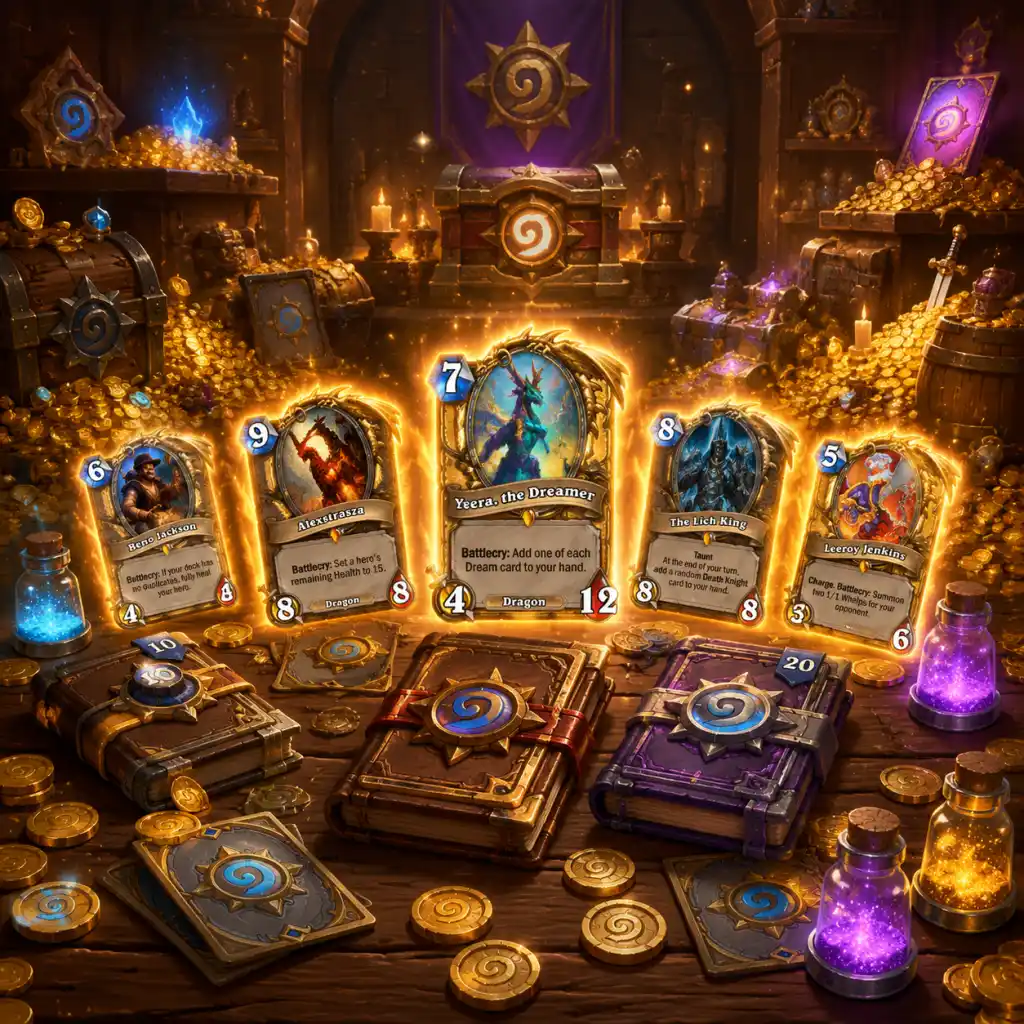
All Game Items
Overview
Hearthstone is a digital collectible card game where the primary "items" are cards and currencies. Unlike traditional RPGs, there are no equippable weapons or armor, but Weapon cards exist as a subtype. This guide covers all major game items: currencies, card packs, cards with subtypes, cosmetics, consumables, and other collectibles. Each entry explains how to obtain the item, when it is useful, and any important synergies or upgrades.
---
Currencies
Gold
- What it does: Used to purchase card packs, Arena tickets, and some cosmetic items. Also required for entry into the Arena mode.
- How to obtain: Earned by completing Daily Quests (40–100 gold each), winning 3 games in Play mode (10 gold per 3 wins, up to 100 gold per day), from the Tavern Pass reward track, and as one-time rewards from achievements, leveling heroes (100 gold every 2 levels), and seasonal events.
- When useful: Always useful. Save gold for new expansion packs (100 per pack) or Arena runs (150 per ticket).
- Synergies: None directly; gold is the universal soft currency.
- What it does: Used to craft any card (except core set and certain special cards). The cost varies by rarity: Common (40), Rare (100), Epic (400), Legendary (1600). Golden cards cost more but are cosmetic.
- How to obtain: Disenchant extra copies of cards from your collection (e.g., a common yields 5 dust, rare 20, epic 100, legendary 400). Also from duplicate protection refunds and seasonal events.
- When useful: Essential for building specific decks. Save dust for key Legendary cards or to complete a deck.
- Upgrades: Golden cards can be disenchanted for more dust than normal but are not necessary for gameplay.
- What it does: Used in the Mercenaries mode to upgrade equipment and abilities. Not used in standard Hearthstone.
- How to obtain: From completing Mercenaries bounties, selling duplicates, and reward track.
- When useful: Only if you play Mercenaries.
- What they are: Contain 5 cards of random rarities (Common, Rare, Epic, Legendary). Guarantees at least one Rare or better. Duplicate protection ensures you don't open more than two copies of a Common or Rare, or more than one of an Epic or Legendary until you own them all for that set.
- Types: Classic (now Core Set, free), Year of the (current expansion), Golden packs, Class packs (contain cards only for that class).
- How to obtain: Purchased with Gold (100 each) or real money. Awarded from Tavern Pass, special events, and Arena/Duels rewards.
- When useful: Open packs from the latest expansion to build your collection. Save gold for new set launches.
- Synergies: Each pack belongs to a specific set (e.g., Showdown in the Badlands). Cards from that set synergize within Standard format.
- Description: Creatures with Attack and Health that can be played on the board. Many have abilities (Battlecry, Deathrattle, Taunt, Rush, Divine Shield, etc.).
- Example: Chillwind Yeti (4 mana 4/5, no ability) – a classic neutral minion.
- How to obtain: Packs, crafting, rewards.
- When useful: Almost all decks rely on minions for board presence.
- Synergies: Tribal tags (e.g., Murloc, Beast, Dragon, Mech) enable tribal synergy cards like Murloc Warleader.
- Description: One-time effects that do not stay on board. They can deal damage, heal, draw cards, buff minions, etc. Have Spell Schools (Arcane, Fire, Frost, Holy, Nature, Shadow, Fel) that enable some synergies.
- Example: Fireball (4 mana, deal 6 damage to a target) – a Mage spell.
- How to obtain: Same as minions.
- When useful: Essential for removal, burn, and combos.
- Synergies: Some minions benefit from casting spells (e.g., Mana Wyrm gains attack). Spell schools matter for cards like Inquisitive Creation (adds a spell from a specific school).
- Description: Equippable items that give the hero Attack and Durability. Attacking with a weapon uses one durability. Weapons can have additional effects (Battlecry, Deathrattle). Only certain classes have weapon cards: Demon Hunter, Hunter, Paladin, Rogue, Shaman, Warrior, Death Knight, and occasionally neutral (like Coghammer).
- Example: Fiery War Axe (3 mana 3/2) – a Warrior weapon from the Classic set.
- How to obtain: Packs, crafting.
- When useful: Control the board by attacking minions or going face. Decks like Pirate Warrior rely on weapons.
- Synergies: Cards that buff weapons (e.g., Upgrade!) or interact with weapon durability (e.g., Captain Greenskin).
- Description: Legendary cards that replace your hero, granting a new Hero Power, Armor, and often a Battlecry. Introduced in Knights of the Frozen Throne and later sets (e.g., Hero cards from Journey to Un'Goro? No, actually KFT and onwards).
- Example: Frost Lich Jaina (9 mana, Battlecry: Summon a 3/6 Water Elemental, gain 5 Armor, Hero Power: Summon a 3/6 Water Elemental with Lifesteal).
- How to obtain: Legendary from the corresponding expansion packs (e.g., KFT packs for Frost Lich Jaina).
- When useful: In control or fatigue decks; they provide game-winning value and unique powers.
- Upgrades: None directly; some hero cards have been moved to Wild format as sets rotate.
- Description: Introduced in Murder at Castle Nathria. They are persistent board items with three durability. Activate their effect at the start of your turn (or when you use a card that references them). Can be targeted by opponents.
- Example: The Scourge (3 mana, 3 Durability, start of turn: Summon a 1/1 Ghoul with Charge that dies at end of turn).
- How to obtain: Packs (epic or legendary).
- When useful: Provide repeated value each turn.
- Synergies: Count as "Location" for cards like Location, Location, Location (Druid spell).
- What they are: Custom back-of-card designs. Purely cosmetic. You can equip one at a time.
- How to obtain: Earned from achieving Rank 5 in a Ranked season (now ranked floors), from special events, pre-ordering expansions, winning in tavern brawls, and buying from the shop (real money).
- When useful: No gameplay impact; used for personalization and bragging rights.
- Collection: All card backs are stored in a menu; some are limited-time exclusive.
- What they are: Alternate art, voice lines, and animations for the 11 hero classes. Some skins are animated with unique emotes.
- How to obtain: Purchased from the Shop (real money or in-game gold during special promotions), earned from completing special achievements (e.g., 1000 wins with a class rewards a golden hero skin), or from pre-ordering expansions (e.g., Magni Bronzebeard for Warrior).
- When useful: Cosmetically changes your hero; no gameplay effect.
- Synergies: Some skins (like Liadrin) are tied to specific classes but no mechanical advantage.
- What they are: Custom coin that appears when you start a game (the coin's art replaces the standard coin).
- How to obtain: Generally from pre-ordering expansions or special events.
- When useful: Cosmetic preference.
- What they are: Alternate board themes, emotes, and minion skins (e.g., Bartender Bob skins).
- How to obtain: Through Battlegrounds reward track (paid Tavern Pass) or shop bundles.
- When useful: Visual enjoyment only; no gameplay impact.
- What it does: Allows one Arena run (construct a deck from random picks, play until 3 losses or 12 wins).
- How to obtain: Purchased with 150 Gold from the Shop, or earned as a reward from special events or the reward track. Also available for real money.
- When useful: To play Arena mode; rewards packs, gold, dust, or even a card (if 12 wins). Good for players who excel at drafting.
- Synergies: None; Arena has its own reward structure.
- What it does: Grants entry to the current Tavern Brawl (free). Some special Brawls may require a ticket but typically no cost.
- How to obtain: The first Tavern Brawl each week is free. Additional entries cost gold (varies, sometimes 50 gold).
- When useful: To play the weekly Brawl for a free pack (first win gives a Classic pack, now a Standard pack).
- What it does: Entry to Duels mode (like Arena but with deckbuilding from a pool). Costs 150 Gold or 1 Duels Token.
- How to obtain: Earned from reward track, shop bundles.
- When useful: For Duels mode.
- The only material used for crafting cards. No other materials exist.
- Hearthstone does not have a crafting material system like in other games. Disenchanting directly yields dust.
- Description: 2-Mana ability available each turn from turn 1 onward. Each class has a default Hero Power (e.g., Mage: Fireblast (deal 1 damage), Paladin: Reinforce (summon 1/1 Silver Hand Recruit)). Hero Powers can be upgraded or replaced by certain cards (e.g., Justicar Trueheart, Hero cards, or spells like Shadowform).
- How to obtain: Default for each class. Upgrades are from cards.
- When useful: Used every turn; key to many strategies (e.g., Warlock Hero Power for card draw).
- Synergies: Cards that interact with Hero Power (e.g., Coldarra Mage, Garrison Commander).
- What they are: 30-card decks given to new players for each class after completing the tutorial. Updated yearly.
- How to obtain: Automatic upon starting the game and completing initial quests.
- When useful: Beginner-friendly introductions, but weak compared to crafted decks.
- What they are: In-game challenges that award XP, packs, gold, card backs, or hero skins. Tracked in the Achievement interface.
- How to obtain: Perform specific actions (e.g., "Play 20 Battlecry minions").
- When useful: Unlocks cosmetic rewards and accelerates Tavern Pass progression.
- What it is: A seasonal progression system rewarding XP, gold, packs, Arena tickets, and cosmetics as you earn XP from play.
- How to obtain: Free for all players; a premium Tavern Pass (paid) adds extra cosmetics and XP boosts.
- When useful: Main source of free items; complete quests to level up.
- Duplicate Protection: Opening packs guarantees you won't get more than the maximum playable copies (2 for Common/Rare, 1 for Epic/Legendary) until you own all cards of that rarity for that set. Golden cards count separately.
- Rotation: Every year, the oldest three expansion sets rotate out of Standard format into Wild. Cards from rotated sets remain playable in Wild and some Tavern Brawls.
- Crafting vs Opening: It's often better to open packs of a new set before crafting to avoid duplicates.
- Real Money Items: Some cosmetics and pre-order bundles are only available with real money (e.g., special hero skins, battlegrounds perks). These are optional.
Arcane Dust
Runes (Mercenaries Currency)
---
Card Packs
Standard Card Packs
---
Cards
Cards are the core items. They are divided into several subtypes. Each card has a Mana Cost (0-10), rarity (Common, Rare, Epic, Legendary), and class or Neutral. Cards are obtained from packs, crafting, rewards, and the Core Set.
Minions
Spells
Weapons
Hero Cards
Location Cards
---
Cosmetics
Card Backs
Hero Skins
Coins
Battlegrounds Cosmetics
---
Consumables / Tickets
Arena Ticket
Tavern Brawl Ticket
Duels Token
---
Materials (Crafting Components)
Arcane Dust (Covered under Currencies)
Enchanting? None.
---
Key Equipment (Hero Powers & Decks)
Hero Powers
Starter Decks (Preconstructed)
---
Other Collectibles
Achievements
Reward Track (Tavern Pass)
---
Important Notes
This guide covers all major item types in Hearthstone. For specific card interactions and deck recipes, refer to the official card library or community sites like Hearthstone Top Decks.