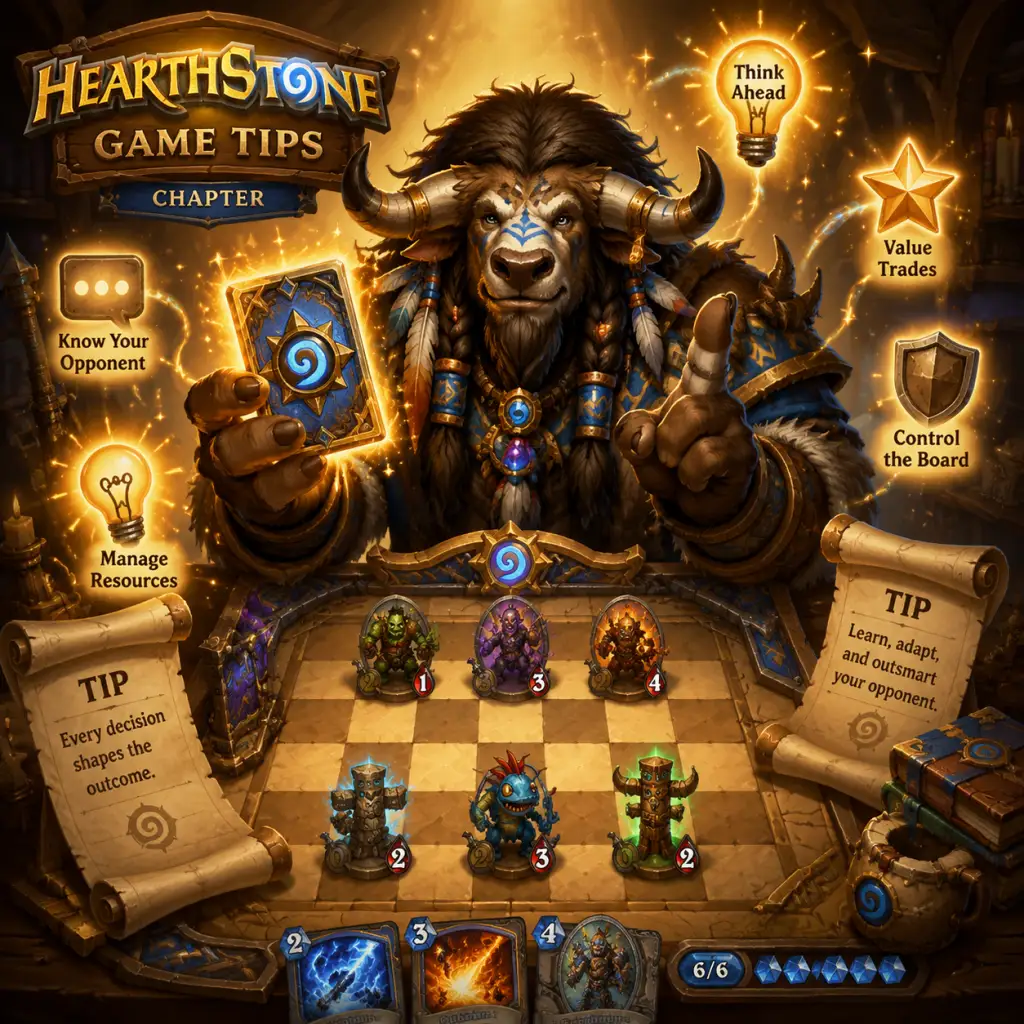
Game Tips
Overview
This guide compiles essential tips for mastering Hearthstone, categorized by skill level and gameplay aspect. Whether you are a new player learning the ropes or a veteran seeking an edge, these strategies cover combat, deck building, resource management, and the in-game economy.
Beginner Tips
Learn the Core Mechanics Thoroughly
- Mana Curve: Ensure your deck has a smooth distribution of cards costing 1 to 7+ mana. A classic rule: include about 8 cards of cost 1-2, 8 of cost 3-4, 8 of cost 5-6, and 6 of cost 7+. This prevents drawing only expensive cards early.
- Trading vs. Going Face: Early game, prioritize trading minions to maintain board control. Only attack the opponent directly if you have lethal damage or if their hero power is irrelevant (e.g., against control decks).
- Hero Power Usage: Use your hero power when you have spare mana. For example, a Mage should ping a 1-health minion rather than wasting a card. Always consider if the 2 mana could be saved for a future turn.
- Face Hunter and Budget Zoo Warlock are cheap, fast, and teach tempo. They require few legendaries and adapt well to the early ladder.
- Why it works: These decks punish slow opponents and let you learn the flow of each class without complex combos. Craft cards like Leper Gnome, Knife Juggler, and Dire Wolf Alpha first.
- Each week, Tavern Brawl offers one free Classic pack. Always complete it, even if you lose (you still get the pack). The rotating rules teach you new interactions.
- Track opponent cards: If a Rogue has kept a card since turn 1, suspect Backstab or Preparation. If a Mage holds a coin and plays slowly, they might have a Mana Wyrm combo. Use this to bait removal.
- Play around common spells: Against Priest, assume they have Shadow Word: Death for your big minion. End your turn with a 4-attack minion (immune to SW:D). Against Paladin, anticipate Consecration on turn 4.
- Include 1-2 tech cards in your deck: Eater of Secrets vs Secret-heavy decks, Blood Knight vs Divine Shield, MCTech vs heavy go-wide strategies. Removing a situational card for a tech card can swing winrates by 5%.
- Check the Hearthstone Meta weekly on sites like HSReplay or Vicious Syndicate. Adjust your deck to counter the top 3 archetypes on ladder.
- General rule: Keep early-game cards (1-3 mana) unless you are playing a combo deck that needs a specific draw. For slow decks, mulligan away high-cost cards for curve filler.
- Class-specific mulligans: Against aggressive decks (e.g., Pirate Warrior), keep board clears like Flamestrike or Lightning Storm even if it costs 7 mana because you need it on turn 5-6.
- Calculate lethal every turn: Even if you don’t have a direct kill, know how much damage you can deal. Sometimes using a removal spell on a taunt instead of saving it allows exact lethal.
- Value trading vs. tempo: Value trading means preserving your minions’ health, while tempo trading means spending mana efficiently. For example, using Fireball on a 4-health minion is pure tempo loss (1 card for 1 card) but could save your 2/3. Only do this if your minion can then attack face.
- Card advantage: Control decks (e.g., Reno Priest) must never over-commit. If you have multiple copies of a card, play only one until the opponent forces a second answer. Save board clears until the opponent commits at least 4+ minions.
- Mana management: In late game, always leave 2 mana for a hero power or a reactive spell (e.g., Anduin’s hero power heals). Knowing when to pass the turn without playing anything is a skill.
- Build around a win condition: Combo decks (e.g., Malygos Druid) need extreme draw power and stalling. Control decks need removal and a finisher (e.g., C’Thun). Aggro decks need low mana curves and burst (e.g., Leeroy Jenkins + Cold Blood).
- Include draw engines: Decks with proactive draw (e.g., Novice Engineer, Azure Drake) perform better than those relying on top-decks. For combo decks, include Arcane Intellect or Nourish.
- Play draw cards before making decisions: If you have Loot Hoarder and a minion to play, play the Hoarder first to draw into more options. This especially matters when deciding between two plays.
- Weapon usage: Equip weapons after attacking with minions, because you can use the weapon’s durability to finish off weak minions. Always check if the weapon swing reduces lethal potential.
- Popping taunts: Use direct damage spells on taunt minions only if you plan to attack face that turn. Otherwise, trade into taunts with minions to preserve spells.
- Auras like Stormwind Champion: Wait until after the opponent clears the aura minion before playing your own minions; otherwise they might get buffed only to be removed immediately.
- Test secrets: If the opponent has a secret from Maddest Scientist or is playing Hunter, attack with a weak minion first to trigger Explosive Trap before playing your key minions.
- Bait removal: Play a medium-sized threat (4/5) to force out Polymorph or Hex, then follow up with your actual finisher.
- Aggro: Win by turn 5-7. Cards like Flame Imp, Vicious Fledgling. You trade only to survive; otherwise go face. Good for fast ladder grinding.
- Midrange: Balanced curve, outvalue opponents through efficient minions. Example: Midrange Shaman with Thunder Bluff Valiant. Takes board then transitions to pressure.
- Control: Survive until late game with removal and heals. Win with a big threat (e.g., N’Zoth, Ragnaros). Requires patience and fatigue management.
- Combo: Assemble pieces (e.g., Exodia Mage). Need heavy draw and stall; fragile if disrupted.
Start with Budget Decks
Use the Innkeeper’s Tavern Brawl for Free Packs
Intermediate Strategies
Hand Reading and Mind Games
Tech Cards and Metagame Adaptation
Mulligan Optimization
Advanced Optimizations
Perfecting the Trade Decision
Resource Planning for Control Decks
Deck Building Synergies
Combat Tips (In-Game Tactics)
Sequencing and Order of Operations
Taunt and Aura Management
Secrets and Baits
Deck Building Tips
Archetype Selection (Exploration of Playstyles)
Card Ratios
| Card Type | Suggested Count |
|---|---|
| Spells | 6-10, depending on class |
| Weapons | 0-4 (for classes that equip) |
| Minions | Rest |
| Endgame threats | 1-3 (e.g., Tirion Fordring, Ragnaros) |
- Why it works: Spells provide direct damage, removal, or draw; weapons offer face damage and board control; minions are your primary board presence.
- Never float mana: If you have 3 mana and nothing to play, use hero power. If your deck regularly floats mana, adjust the curve (add more 2- and 3-drops).
- Consider Overload (Shaman): Plan ahead. If you overload 2 next turn, your turn 4 becomes turn 2 mana-wise. Don’t overload near a turn you need a key spell.
- Card advantage: Gaining more cards than opponent via draws or multiple effects (e.g., Sprint). Use when opponent is slow or you can afford the tempo loss.
- Tempo: Spending mana efficiently to control the board. Playing a 4/5 on turn 4 is tempo positive. Sometimes you use Fireball on a 3/2 because that keeps your 5/5 alive – that’s tempo, not value.
- Your health is a resource: Against aggro, trade heavily to preserve health. Against control, you can afford to take damage in exchange for card advantage. Know when to tap (Warlock hero power): do it early if you have no play, but avoid tapping below 10 health against burst classes.
- Daily Quests: Always reroll 40-gold quests hoping for 50 or 60 gold. Complete all quests every 3 days to maximize gold per time.
- Arena vs. Buying Packs: If you average less than 3 wins, buy packs directly. If you average 5+ wins, Arena is better for value. Use tools like HearthArena to draft better.
- Crafting Priorities: For beginners, craft neutral cards that fit many decks: Piloted Shredder, Doctor Boom (Classic), Azure Drake (classic). Avoid crafting niche legendaries until you have a full collection.
- Never disenchant cards unless you need dust for a key legendary. If you must, dust duplicates only (keep at least 2 copies of common/rare, 1 of epic/legendary).
- Golden cards: Disenchant goldens if you are F2P, unless you plan to collect (they give more dust than normal).
- Adventures (e.g., One Night in Karazhan, Curse of Naxxramas) give guaranteed high-value cards and are often better per gold than random packs. Complete all wings before buying packs.
- Use Hearthstone Deck Tracker and HSReplay to review your games. Identify every misplay: Did you miss lethal? Did you waste a removal spell? Did you over-commit to a Brawl? This improves decision-making.
- Record your mulligans: After the game, check if you kept a card that ended up being a dead draw. Adjust your mulligan rules accordingly.
- Pretend to have a card: Play a slow turn (e.g., hero power and pass) to make the opponent think you have a board clear. This can cause them to overextend or play around a spell you don’t have.
- Emote usage: Your emotes can tilt opponents. Use „Well played” sarcastically after a lucky draw to provoke misplays (though risky).
- Alexstrasza (dragon): Use to set opponent to 15 health only if you have lethal next turn or a burst combo. Using it on yourself is often wrong unless you have armor synergy.
- Tirion Fordring: Play him when opponent has no silence. If they have Hex, consider baiting it first.
Resource Management
Mana Crystals and Curve Efficiency
Card Advantage vs. Tempo
Health Management
Economy Tips
Free-to-Play (F2P) Gold Management
Dusting Decisions
Adventure vs. Packs
Advanced Optimizations (Revisited)
Replay Analysis and Tracking
Mind Games and Baiting
Key Timing for Legendary Plays
Conclusion
Hearthstone mastery comes from constant learning and adaptability. Apply these tips incrementally: start with the beginner section, then incorporate intermediate strategies as you climb ranks. Use external tools to track your progress, and never stop refining your plays. Good luck on the ladder!