Character Skills
Overview
Little Nightmares II is a horror puzzle-platformer without traditional skill trees, cooldowns, or upgrade systems. The two primary characters—Mono (the player-controlled protagonist) and Six (the AI-controlled companion)—have a set of innate abilities that are essential for survival and puzzle-solving. This guide covers every action and interaction available to both characters, including how to use them effectively, when to deploy them, and how Mono and Six synergize. While no skills can be upgraded or combined in a menu, mastering these abilities is the key to progressing through the game's treacherous environments.
---
Mono – Player-Controlled Skills
Mono is a small, frail boy wearing a paper bag. His skills are purely physical and require precise timing and environmental awareness.
1. Walking & Sprinting
- Effect: Move left or right at a default pace. Hold the sprint button (Shift on PC, R2/RT on console) to run faster.
- Cooldown: None; sprinting can be maintained indefinitely but is noisy and attracts enemies.
- When to Use: Sprinting is useful for short bursts to escape threats or cross gaps before platforms collapse. Avoid sprinting near enemies like the Hunter or the School Teacher, as noise alerts them.
- Effect: Press crouch (Ctrl on PC, L3 or circle/B on console) to lower Mono’s profile. While crouched, movement is silent and Mono can fit under low obstacles.
- Cooldown: None.
- When to Use: Essential for stealth sections. Use when stalking past the Hunter in the woods, crawling through vents, or hiding under desks from the Teacher.
- Effect: When an enemy is close and searching, you can hold the interact button (E on PC, X/Square on console) to make Mono freeze and hold his breath, reducing the chance of detection.
- Cooldown: None, but you must release the button normally after the danger passes.
- When to Use: In tight spaces where hiding is unavailable. Most effective against the Doctor and the Thin Man.
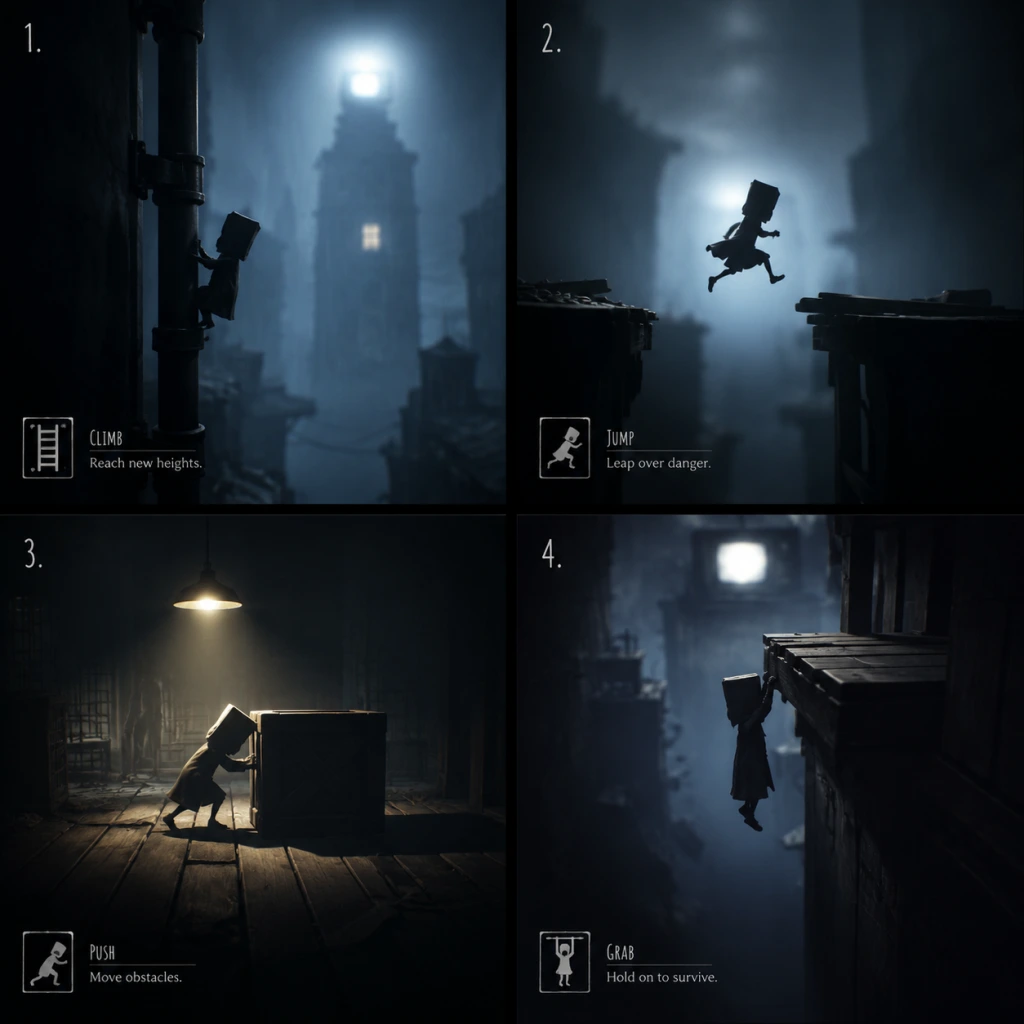
- Effect: Press jump (Space on PC, A/Cross on console) to leap across gaps, onto ledges, or up onto platforms. While airborne, you can grab climbable edges (automatically). Climbing is context-sensitive on ladders, pipes, and chains.
- Cooldown: None. Jump height is fixed; no double jump or air control.
- When to Use: For all platforming. Note that Mono cannot climb certain vertical walls; look for handholds or vines. Synergy: Six can boost Mono up to higher ledges (see Six skills).
- Effect: Press the interact button to pick up objects (keys, weapons, dolls), open doors, pull levers, push blocks, or use items.
- Cooldown: None. You can drop or swap items at any time.
- When to Use: Constantly. Almost every puzzle requires interacting with the environment. Holding a weapon (pipe, axe, hammer) allows Mono to attack certain enemies (like the Hunter's traps or the Mannequins).
- Effect: When holding a melee weapon, press the attack button (left mouse button on PC, R1/RB on console) to swing. This can break fragile obstacles, stun enemies, or kill specific foes (e.g., the Hunter after being shot, or the Mannequins).
- Cooldown: There is a brief recovery animation after each swing (about 1 second).
- Upgrades: None. The weapon’s effectiveness depends on the target; an axe can break doors, a pipe can shatter glass, a hammer can smash porcelain dolls.
- When to Use: Use attacks sparingly because they make noise and can alert nearby enemies. Best used for one-hit-kill opportunities (e.g., hitting the Mannequins after they freeze in light).
- Effect: After acquiring the flashlight, press the interact button to turn it on/off. While on, it illuminates dark areas and can stun the Mannequins (they freeze when caught in the beam).
- Cooldown: None. No battery drain; can be used indefinitely.
- When to Use: Essential in the School and Hospital levels. Always keep it on while moving through dark corridors. Use the beam to scan for threats and freeze Mannequins before attacking them.
- Effect: Keys and similar items are held in Mono’s hands. They block the use of other weapons/shields. Keys are used to unlock doors or machinery.
- Cooldown: None.
- When to Use: Follow visual cues—a keyhole or mechanism next to a gate. Never drop a key in a dangerous area; carry it to its destination.
- Effect: Six carries a lighter that always emits a small flame, providing ambient light in dark areas. She automatically holds it up when needed.
- Cooldown: Always active (never runs out).
- When to Use: Her light is less strong than Mono’s flashlight but helpful for navigating and spotting enemies. It also reveals hidden symbols and clues.
- Effect: At certain platforms, Six will crouch down to allow Mono to jump on her shoulders and reach higher ledges. This is an automatic scripted action when Mono stands near her at the correct spot.
- Cooldown: Only occurs at predetermined puzzle points.
- When to Use: Look for tall obstacles that are above Mono’s jump height. Approach Six and press the interact prompt. She will always be available for boosts when needed.
- Effect: Six can perform actions like pulling levers, turning valves, or holding doors open when Mono is doing something else. She reacts to Mono’s position and contextual cues.
- Cooldown: Part of scripted sequences.
- When to Use: You do not control this directly. When you see a puzzle requiring two people (e.g., a valve that must be turned while another is pressed), interact with your part and Six will automatically handle the other.
- Effect: Six occasionally makes small noises (coughs, footsteps) that can inadvertently alert enemies. This is usually a downside, but sometimes it can be used to lure enemies away from Mono’s hiding spot (unreliable).
- Cooldown: Random, but frequent.
- When to Use: Be aware that Six may cause unwanted attention. Hide in closets or behind furniture to minimize detection. Occasionally, you can use her presence to bait enemies into traps, but this is not a reliable skill.
- Effect: Six will point or gesture in the direction of the next objective. She also shows fear or urgency (e.g., shaking when an enemy is near).
- Cooldown: Continuous.
- When to Use: Watch Six’s animations to get hints about where to go or if danger is imminent. Her pointing is especially helpful in confusing maze-like areas (e.g., the Hospital).
- In the School, Mono must hold a lever while Six climbs a rope to open a door.
- In the Hospital, Mono uses the flashlight to freeze a Mannequin while Six retrieves a key.
- In the final chapter, Six must be at a specific location to open a gate while Mono pulls a switch.
- Focus: Crouching, Holding Breath, minimal interaction.
- Best For: The Wilderness (Chapter 1) and the School (Chapter 3) where enemies are patrol-based.
- Strategy: Never sprint. Learn patrol routes. Use hiding spots (wardrobes, under beds). Let Six stay behind you.
- Focus: Using the pipe/axe/hammer to break obstacles and stun enemies.
- Best For: The Hospital (Chapter 4) where Mannequins can be killed with the flashlight + weapon combo.
- Strategy: Keep weapon equipped, use flashlight to freeze enemies, then attack. Break doors and shelves for shortcuts.
- Focus: Carrying keys, using flashlight, exploiting Six’s cooperation.
- Best For: Chapter 2 (The City) and Chapter 5 (The Signal Tower).
- Strategy: Examine every interactive object. Use Six’s boost at every opportunity. Pay attention to Six’s pointing—it often indicates the next key or puzzle step.
2. Crouching & Sneaking
3. Holding Breath
4. Jumping & Climbing
5. Grabbing/Interacting
6. Attacking (Weapon Swing)
7. Flashlight (Chapter 3 – School)
8. Key/Item Interaction
---
Six – AI Companion Skills
Six is an AI-controlled character who follows Mono throughout most of the game. She cannot be directly commanded but will perform actions that aid progression.
1. Light Source (Lighter)
2. Boost / Lift
3. Cooperative Puzzle Solving
4. Distraction / Noise
5. Emotional Support (Visual Commands)
---
Synergies Between Mono and Six
Combined Puzzle Solving
Many puzzles require both characters to act simultaneously. For example:
Combat Synergy
Six never directly attacks. However, Mono can use weapons (pipe, axe) to defeat enemies while Six provides light or distraction. In the Hunter’s cabin, Six will hide in a wardrobe while Mono creates noise to distract the Hunter, then both escape.
Stealth Synergy
Six is often the one who triggers alarms inadvertently. To avoid this, move slowly through areas with enemies and stay close to each other. If Mono crouch-walks, Six will also crouch. This is essential for stealth segments.
---
Recommended “Builds” (Situational Strategies)
Because there are no customizable skills, “builds” refer to how you approach each chapter with the tools available.
Stealth-First Build
Aggressive Build (Weapon Heavy)
Puzzle-Solving Build (All Items)
---
When to Use Each Skill (Quick Reference Table)
| Skill | Character | Primary Use Case | Enemy Type | Danger Level |
|---|---|---|---|---|
| Sprint | Mono | Escape collapsing floors or chasing enemies | Hunter, Thin Man | High (noisy) |
| Crouch | Mono | Stealth past patrolling enemies | Hunter, Teacher, Doctor | Low (silent) |
| Hold Breath | Mono | Near enemies in hiding spots | All enemies | Medium (prevents detection) |
| Jump | Mono | Gap crossing, climbing ledges | N/A | Low |
| Attack (Weapon) | Mono | Kill stunned Mannequins, break objects | Mannequin, Doctor (scripted) | Medium (noise) |
| Flashlight | Mono | Stun Mannequins, illuminate dark areas | Mannequins | Low (reveals threats) |
| Lighter | Six | Ambient light, reveals secrets | N/A | Low |
| Boost | Six | Reach high ledges (puzzle required) | N/A | None |
| Cooperative Action | Both | Two-person puzzles (levers, valves) | N/A | None (scripted) |
Important Notes on Skill Limitations
- No Skill Tree: You cannot unlock new abilities or upgrade existing ones. The skills described are all you will ever have.
- No Cooldowns: All actions can be performed consecutively, but animations (e.g., swing recovery) introduce a brief delay.
- No Combos: There are no attack chains or special moves. The only “combo” is using the flashlight to freeze a Mannequin then hitting it with a weapon.
- Item Dependency: Many skills require a specific item (flashlight, weapon). If you drop the item, you lose the ability until you pick it up again.
- Six’s Autonomy: You cannot control Six’s actions directly. If she fails to cooperate due to a bug, restart from the last checkpoint.
---
Conclusion
Little Nightmares II’s character “skills” are minimal but deeply integrated into the environment and enemy behavior. Mastery comes from knowing when to sprint or sneak, how to use Six’s AI assistance, and which weapon works best in each situation. Focus on observation and patience—the game rewards careful use of these abilities over reckless action.