Characters & Roles
Overview
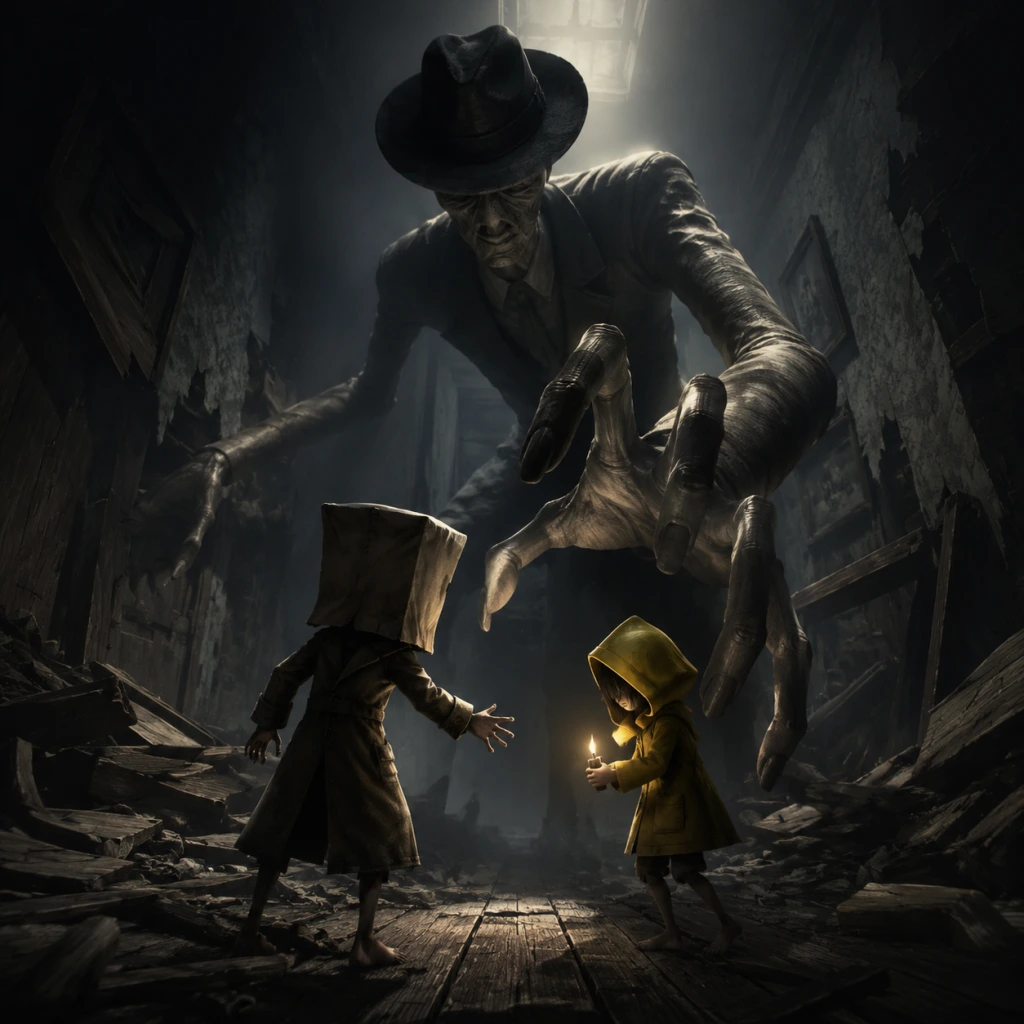
Little Nightmares II features a small cast of deeply characterized individuals, but only two are directly controlled or guided by the player: Mono (the protagonist you control) and Six (the AI companion who follows you). The antagonists—The Hunter, The Teacher, The Doctor, The Thin Man, and the Viewers—are not playable but are essential to the experience. This guide covers every major character that appears in the game, focusing on their background, gameplay role, strengths, weaknesses, and how they interact with the world and each other. Since the game has no traditional classes, skill trees, or unlockable equipment, the “build” and “team synergy” sections are adapted to the limited items and cooperative moments available.
---
Playable Characters
Mono
#### Background
Mono is a young boy wearing a brown paper bag over his head. He awakens in a dark forest and must traverse a twisted world to rescue a girl named Six. His true identity and the reasons for his journey are revealed only at the climax of the story. He possesses no special powers, only his wits, agility, and an uncanny ability to use everyday objects as tools or weapons.
#### Strengths
- Agility and Climbing: Mono can vault over obstacles, shimmy across ledges, climb chains, and squeeze through tight spaces. He is faster than most enemies when sprinting.
- Object Interaction: He can pick up, carry, and throw items such as shoes, pipes, bricks, and axes. Thrown objects can stun enemies, break glass, or activate distant switches.
- Stealth Core: His small size allows him to hide under beds, inside lockers, behind curtains, or in shadows. He can peek around corners and hold his breath to avoid detection.
- Flashlight Utility: While not a weapon, the flashlight reveals hidden paths, disorients some enemies briefly, and is essential in dark areas.
- Frail and Unarmed: Mono cannot take a single hit from any enemy. Direct contact means instant death and a reload from the last checkpoint.
- Limited Inventory: He can only carry one large item at a time (e.g., a pipe). Smaller items like shoes or bricks can be held in his hand but must be thrown to free up his hands.
- No Permanent Upgrades: There is no health bar, stamina meter, or ability progression. Every encounter relies on player skill rather than character growth.
- Slow for Puzzles: Carrying heavy items slows his movement and prevents sprinting, making him vulnerable in chase sequences.
- Empty Hands: Best for sprinting and climbing quickly.
- Shoe: Useful for reaching high ledges (stand on it) or for throwing to create noise. Only one shoe appears per area, so use it wisely.
- Pipe / Axe / Brick: Best for stunning enemies or breaking barriers. Remember that after throwing a weapon, it is gone unless you retrieve it.
- Flashlight: Always keep it on in dark sections; it can momentarily blind The Hunter when he is close, giving you time to escape.
- Pull levers while Mono holds a door open.
- Provide a boost to reach higher ledges (Mono steps on Six’s hands).
- Hide in cupboards while Mono distracts enemies.
- Hand items to Mono through gaps.
- Leave a hiding spot to reunite after danger passes.
- Small and Silent: Six is even smaller than Mono and can fit into tighter hiding spots (e.g., inside a small cabinet). She never makes noise unless scripted (screaming when grabbed).
- Cooperative Actions: She can perform specific actions that Mono cannot do alone, such as pulling levers from opposite sides or boosting Mono to higher platforms.
- Distraction Potential: If Mono is hidden, Six may wander into an enemy’s line of sight, causing the enemy to move towards her and away from Mono’s path.
- Immune to Some Hazards? Six cannot be killed by the environment (falling into pits, drowning) as she will simply teleport to Mono. However, enemies can grab and kill her, resulting in a game over.
- AI Limitations: Six does not always follow the optimal path. She may get stuck on geometry or fail to react quickly in chase sequences.
- Vulnerable to Enemies: If Six is caught by an enemy, the game ends instantly. You cannot control her defense—she will run or hide automatically but is not guaranteed to escape.
- No Direct Commands: You cannot tell Six where to go or what to do. She acts based on triggers in the environment.
- Can Be Left Behind: If you progress too fast, Six may not be able to catch up, and a closed door or rising water can trap her, causing a reset.
- She can pick up and hold certain items (like a key) but only as part of a scripted interaction.
- You cannot give her items manually; she will only take what the puzzle demands.
- Boosting: When Mono stands near a high ledge, Six will cup her hands. Jump onto her hands and then press the action button to boost upward.
- Simultaneous Actions: Some doors require both characters to pull levers at the same time. Mono must be at his lever; Six will automatically go to hers when you interact with yours.
- Hiding Together: Both can hide in the same closet or under the same bed. If one is spotted, the other is often safe if not in line of sight.
- Item Handoffs: In the school and hospital, Six can pass items through small holes or over low walls. She will automatically do so when you position Mono correctly.
- Background: A hulking, deformed man who dwells in the forest and operates a derelict shack. He captures Six and hangs her from a meat hook. He is obsessed with hunting and taxidermy.
- Role: The first major enemy encountered. He appears in the opening chapter and later chases Mono through his property.
- Strengths: He carries a shotgun that can kill Mono instantly from range. He is relentless and has keen hearing (footsteps attract him).
- Weaknesses: He is slow when not alerted, can be stunned by a thrown object (shoe, brick), and cannot climb through small gaps. He also cannot see Mono if hidden in tall grass or inside a wardrobe.
- Encounter Strategy: Stay low, move quietly (crouch-walk), use tall grass for cover, and throw objects to create noise away from your path. In the cabin chase, use quick sprints between hiding spots like under beds or in cabinets. The shotgun blast has a short wind-up—listen for the click and move before he fires.
- Background: A porcelain-skinned, long-necked creature who runs a twisted school. She is warped by the environment and seems to be searching for lost students.
- Role: Appears in the School chapter. She patrols classrooms and hallways, and can extend her neck to an unnatural length to spot Mono from above.
- Strengths: Her neck can reach across rooms and through small openings, making high hiding spots unsafe. She moves silently. Her chalkboard pointer can knock items out of Mono’s hands.
- Weaknesses: She is slow when walking normally. She cannot crouch, so low hiding spots under desks or in cabinets are safe. If you hide inside a locker, she will eventually leave.
- Encounter Strategy: Keep to the shadows under desks and inside cabinets. Move only when her back is turned or when she is at the far end of the hallway. Use thrown chalk or pencils to distract her. If she spots you, run to the nearest hiding spot—she will search but not chase forever.
- Background: A blind, gangly surgeon who runs a crumbling hospital. He has a hearing problem and relies on sound to locate prey. He uses a scalpel and sometimes chases Mono with alarming speed.
- Role: Primary antagonist of the Hospital chapter. He appears in operating rooms, corridors, and morgue-like areas.
- Strengths: Extremely fast when sprinting (faster than Mono). He can break through flimsy furniture and open lockers. His scalpel causes instant death. He is attracted to any noise, including footsteps, dropped items, or even Mono’s flashlight beam.
- Weaknesses: He is blind—if you stand still and hold your breath, he will walk past you. He cannot see you if you are completely immobile and silent. He also becomes confused if you create a noise far away and then hide.
- Encounter Strategy: Move only when he is not nearby. When he is close, freeze and hold your breath (press the control stick not at all). Use thrown organs or objects to lure him away. If you need to run, wait until he turns his back and sprint to the next safe spot. Never run in a straight line; zigzag if he is chasing.
- Background: A towering, gaunt figure in a suit, with a television for a face. He is the ultimate puppet master, responsible for the twisted world Mono and Six traverse. He can teleport through televisions and manipulate reality.
- Role: Final boss and true antagonist. He appears in the final chapter, the Signal Tower. He is encountered in a series of surreal chase sequences and a final confrontation.
- Strengths: He can teleport behind Mono instantly, create clones, alter the environment (change corridors, shift walls), and shoot beams that turn Mono to static. His presence is oppressive and hard to escape.
- Weaknesses: He cannot enter certain safe zones (small crawlspaces, behind certain projections). He is vulnerable to light—exposing him to bright light (from the TV static or the flashlight) momentarily stuns him. The final confrontation relies on Mono using a long pipe to stun him repeatedly.
- Encounter Strategy: In chase sequences, run through the predetermined path and use tight corners to break line of sight. In the final fight, you must time your swings with the pipe to interrupt his attacks. Keep moving to avoid his teleport grab.
- Background: The twisted, glitching inhabitants of the Pale City. They are mesmerized by televisions and are essentially zombies—slow, shambling, and attracted to sound and light.
- Role: Minor enemies that appear in the city sections. They are not individually dangerous but can swarm and grab Mono if he gets too close.
- Strengths: Numbers—they often appear in groups. They can climb over low obstacles (tables, chairs). Their grab causes instant death.
- Weaknesses: Very slow. They cannot move through small gaps or climb up ledges. They are easily distracted by thrown objects or breaking glass. They will stop chasing if you hide in a closet for a few seconds.
- Encounter Strategy: Avoid direct confrontation. Walk past them while they are staring at TVs. If one sees you, run a short distance and hide. Use thrown items to clear a path. Never sprint near them as the sound attracts more.
#### Weaknesses
#### Playstyle
Mono’s gameplay is a mix of stealth, puzzle-solving, and precision platforming. You must constantly analyze enemy patrol patterns, choose when to run and when to hide, and use thrown objects to create distractions or stun foes. Combat is almost never a viable option except for the final confrontation. The key is patience and observation.
#### Unlock Conditions
Mono is the default player character and is available from the very first moment of the game. No unlock required.
#### Recommended Equipment / Build
Since there is no RPG equipment system, the most effective “loadout” is situational:
There is no way to customize Mono’s abilities. The only “build” is how you choose to use the limited items at your disposal.
#### Team Synergy (with Six)
Mono and Six must work together to solve puzzles. Six can:
Six does not follow a direct command—she reacts to the environment. If Mono gets too far ahead, she will catch up automatically. If danger is near, she will hide or freeze. Player timing is critical, as Six cannot be left behind when doors close or elevators move.
---
Six
#### Background
Six is the protagonist from the first Little Nightmares game. She is a small, raincoat-wearing girl who has escaped the Maw and now appears in Mono’s world. She is initially a lost child, captured by The Hunter, and Mono must free her. After rescue, she follows Mono faithfully, but her past trauma and hunger for souls (as shown in the original game) eventually surface during the finale. She is AI-controlled with limited autonomy.
#### Strengths
#### Weaknesses
#### Playstyle
For the player, Six is a tool rather than a second character to manage. The main playstyle is to lead the way, solve puzzles that require her assistance, and keep an eye on her position. When she is far behind, wait for her. When she is in danger, create a safe path. The puzzle sections are designed so that you must coordinate with her AI behavior, which usually means pulling a lever while she stands on a pressure plate, or throwing an object that she can then hand back to you.
#### Unlock Conditions
Six joins Mono automatically after completing the first chapter (The Woods) and rescuing her from the Hunter’s shack. She remains with Mono for the rest of the game, except during the final confrontation.
#### Recommended Equipment / Build
Six has no inventory or equipment. The only way to “equip” her is through the environment:
There is no build customization for Six. Your strategy should focus on positioning her correctly by moving to the right trigger points.
#### Team Synergy (with Mono)
---
Non-Playable Characters (Antagonists)
While not playable, these major characters are central to the story and gameplay. They function as obstacles that must be avoided or outsmarted.
---
The Hunter
---
The Teacher
---
The Doctor
---
The Thin Man
---
The Viewers
---
Summary Table
| Character | Type | Role | Key Strength | Key Weakness |
|---|---|---|---|---|
| Mono | Playable (Protagonist) | Stealth/puzzle solver | Agility, object use | Fragile, no health |
| Six | AI Companion | Puzzle assistant | Small size, cooperative actions | Limited AI, vulnerable |
| The Hunter | Antagonist (Chapter 1) | Chase/pursuit enemy | Shotgun, hearing | Slow when unalerted |
| The Teacher | Antagonist (Chapter 2) | Patrol/vision enemy | Extended neck sight | Can’t detect low hiding spots |
| The Doctor | Antagonist (Chapter 3) | Pursuit/stealth enemy | Fast sprint, noise detection | Blind (only hears) |
| The Thin Man | Final Boss | Reality warp/chase | Teleport, beam attacks | Stunnable by pipe/light |
| The Viewers | Minor Enemies (City) | Swarm obstacles | Numbers | Very slow, predictable |
Final Notes
Little Nightmares II focuses on atmosphere and narrative rather than character progression. Mono and Six are not classes or heroes you can customize; their identities are fixed and tied directly to the story. The true “role” you play is that of a survivor guiding a child through a nightmare, using only cunning and borrowed tools. Mastery comes from learning enemy behaviors, optimizing stealth routes, and understanding when to cooperate with Six. No matter how you play, the ending remains the same—but the journey’s quality depends entirely on your stealthy wits.