Core Gameplay
Overview
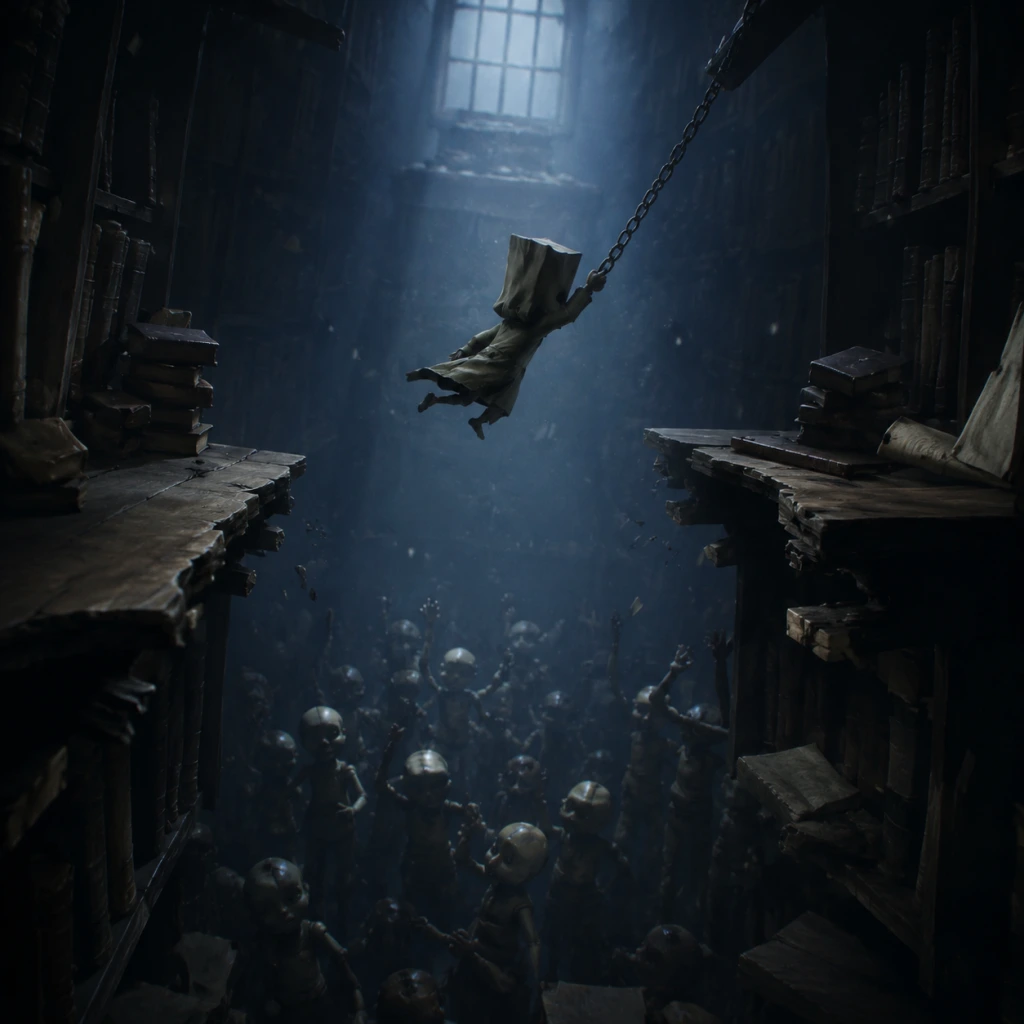
Little Nightmares II is a 2.5D puzzle-platformer horror adventure where you play as Mono, a young boy wearing a paper bag over his head. The core gameplay loop revolves around stealth, environmental puzzle-solving, and evading grotesque enemies. Unlike many action games, you have no traditional combat—Mono is fragile and must rely on wits, the environment, and occasional items to survive. The game is structured into five chapters (The Wilderness, The School, The Hospital, The Pale City, The Signal Tower), each introducing new mechanics and threats. Progression is linear, exploration is rewarded with collectibles and lore, and there is no character leveling, economy, or endgame beyond completing the story. Below is a breakdown of core gameplay by player progression tiers, with detailed explanations and examples.
The Main Gameplay Loop
The loop in Little Nightmares II is simple yet tense:
1. Explore a dark, claustrophobic environment to find the path forward.
2. Solve puzzles—often involving moving blocks, pulling levers, using objects (e.g., a key, a shoe) to unlock doors or activate mechanisms.
3. Evade or outsmart enemies—use stealth (crouch, hide under beds, avoid line of sight) or temporary tools (e.g., a hammer to stun) to survive.
4. Progress to the next area—each section ends with a door, elevator, or transition that loads the next area.
5. Uncover story fragments via VHS tapes, drawings, and environmental storytelling.
This loop repeats throughout the 4–6 hour campaign, with increasing complexity and horror.
Combat and Interaction Systems
No traditional combat: Mono cannot attack directly. The only offensive action is using a thrown object (e.g., a brick, a broken bottle) to stun an enemy briefly, giving you time to run. This is not a kill—just a delay.
- Grab: Interact with objects, pull levers, pick up items.
- Drop: Release held item.
- Run/Sprint: Tap to sprint (limited duration; stamina depletes quickly).
- Crouch/Crawl: Essential for stealth; hide under furniture or in vents.
- Jump: Context-sensitive; hold run to jump farther.
- Swim/Duck under water: Some sections require holding breath.
- Swing (with weapon): In certain sections (e.g., The School), you can swing a makeshift weapon (like a pipe or hammer) to stun enemies—but never kill them.
- Linear story chapters: The game is strictly linear. You cannot return to previous chapters. Save points (projector screens) auto-save progress; death respawns at the last save point.
- No leveling or skill trees: Mono does not gain new abilities. The only progression is your own skill and understanding of puzzles and enemy patterns. You acquire new interactions (e.g., swinging a pipe, using a flashlight) as the environment provides them, but these are temporary tools, not permanent upgrades.
- Collectibles: There are 30 Mono’s Hats (cosmetic only) and 36 VHS Tapes (lore). No gameplay benefit.
- 3D environments in a 2.5D plane: You can move left/right, up/down ladders, and forward/backward in some rooms. Exploration is encouraged off the main path to find collectibles and hidden rooms.
- Puzzle solving as exploration: Many collectibles require lateral thinking—e.g., using a thrown object to break a window or using a lever to raise a platform.
- Environmental storytelling: Game world tells the story through imagery; no dialogue. Exploration reveals how the world fell to the Signal Tower’s influence.
- No quest log or explicit missions. The only objective is stated through environmental cues: reach the door, turn on the generator, cross the gap. The game is essentially one continuous “quest” to escape the Pale City and reach the Signal Tower.
- Sub-objectives appear contextually: e.g., “Find a way to turn on the TV” or “Get the key from the hanging man.” These are immediate puzzles.
- No currency, shops, or upgrades. There is no economy. The only “resource” is collected hats (cosmetics) and tapes (lore enrichment). No in-game purchases or microtransactions.
- No growth system. Mono starts and ends exactly the same. The only change is your companion, Six, who is present for most of the game and can assist in certain situations (e.g., standing on a switch, giving you a boost). She does not gain abilities either.
- AI companion: Six is controlled by the game’s AI. She will follow, hide, and help with specific puzzles. She cannot die permanently—if she is grabbed, you must rescue her quickly.
- No post-game content. After completing Chapter 5 (The Signal Tower), the credits roll. There is no New Game Plus, no free roam, and no difficulty levels. The only replay value is to collect all hats and VHS tapes, or to unlock achievements/trophies.
- Multiple endings? The game has one canonical ending (with a twist). The ending is the same regardless of collectibles.
- Speedrun potential: The linear nature and lack of upgrades make it a popular speedrun game.
- Objective: Escape the Hunter’s cabin and the surrounding forest.
- New mechanics: Crouch, hide, push/pull objects, throw items. First encounter with an enemy (the Hunter).
- Puzzles: Simple: use a shoe to attract Hunter, rotate a valve to lower a bridge, climb trees to avoid traps.
- Exploration: Limited area; collectible hats hidden in side rooms (e.g., the bear hat behind a locked door).
- Difficulty: Low. Game teaches basic controls and stealth. Deaths are forgiving.
- Example puzzle: In the cabin, you must pull a chair to reach a high shelf, then push a TV to create a light beam that reveals hidden door.
- Objective: Survive the mannequin-filled school and the grotesque Hospital.
- New mechanics: Use of weapons (e.g., pipe in the school to stun the Bullies). Stealth becomes critical; enemies patrol in patterns.
- Puzzles: Multi-step: e.g., in the School, you must lure a Bully into a classroom by throwing a bottle, then sneak behind and hit a lever. In the Hospital, use a wheeled bed to reach high vents.
- Exploration: More branching paths; some areas require backtracking within the same room.
- Difficulty: Moderate. Enemies are more aggressive; one hit kills you. Save points become less frequent.
- Example puzzle: The Hospital’s operating room: you must dodge the Doctor by hiding under a gurney while he performs surgery, then grab the key from his table without being seen.
- Objective: Navigate the decaying city streets and the TV-obsessed citizens.
- New mechanics: Use of a flashlight (temporary) to reveal hidden platforms; enemies that are attracted to light/sound. The Viewers (zombie-like figures) require careful movement to avoid.
- Puzzles: Complex timing and sequence: e.g., using a television to distract a group of Viewers, then sprinting across a gap. Some puzzles involve manipulating light beams.
- Exploration: Verticality—climb scaffolding, crawl through subway cars. Several hidden rooms with tapes.
- Difficulty: High. Tight timings; long sequences without save points. Enemies can kill instantly.
- Example puzzle: The music box room: you must turn off three TVs in a specific order to disable a fan, then jump across rotating platforms.
- Objective: Reach the top of the tower and confront the Signal Tower’s influence. This is the final and most surreal chapter.
- New mechanics: No new tools; environmental puzzles become abstract. Glitches in reality (inverted gravity, repeating rooms).
- Puzzles: Purely environmental: walk on walls, avoid invisible enemies, navigate distorted geometry.
- Exploration: Linear, but with multiple “fake” doorways that loop; you must identify the correct path by observing subtle clues.
- Difficulty: Very high due to disorienting visuals and limited save points. Final chase sequence requires perfect timing.
- Example puzzle: A room where you must walk upside down on the ceiling to reach a door, while avoiding falling debris. Only the correct path (indicated by a faint glow) is safe.
Example: In the Hunter’s cabin (Chapter 1), you find a shoe that can be thrown at a door to attract the Hunter’s attention, allowing you to sneak past. No direct attack.
Progression
Exploration
Example: In The Hospital (Chapter 3), you can break a glass case by throwing a doll at it, revealing a VHS tape that explains the origins of the Doctor.
Quests and Missions
Economy
Character and Build Growth
Endgame Structure
Core Gameplay by Progression Tiers
Early Game (Chapter 1: The Wilderness)
Mid Game (Chapters 2–3: The School & The Hospital)
Late Game (Chapter 4: The Pale City)
Endgame (Chapter 5: The Signal Tower)
Summary
Little Nightmares II is a pure horror puzzle-platformer with no traditional RPG mechanics. Its core gameplay focuses on stealth, environmental puzzles, and evasion, with progression measured purely by player skill and exploration. The tiers map directly to chapters: Early (Wilderness), Mid (School/Hospital), Late (Pale City), Endgame (Signal Tower). There is no economy, character builds, or endgame content—the experience is a tightly crafted, linear story. Replayability comes from collectibles and speedrunning.