Core Gameplay
Core Gameplay Overview
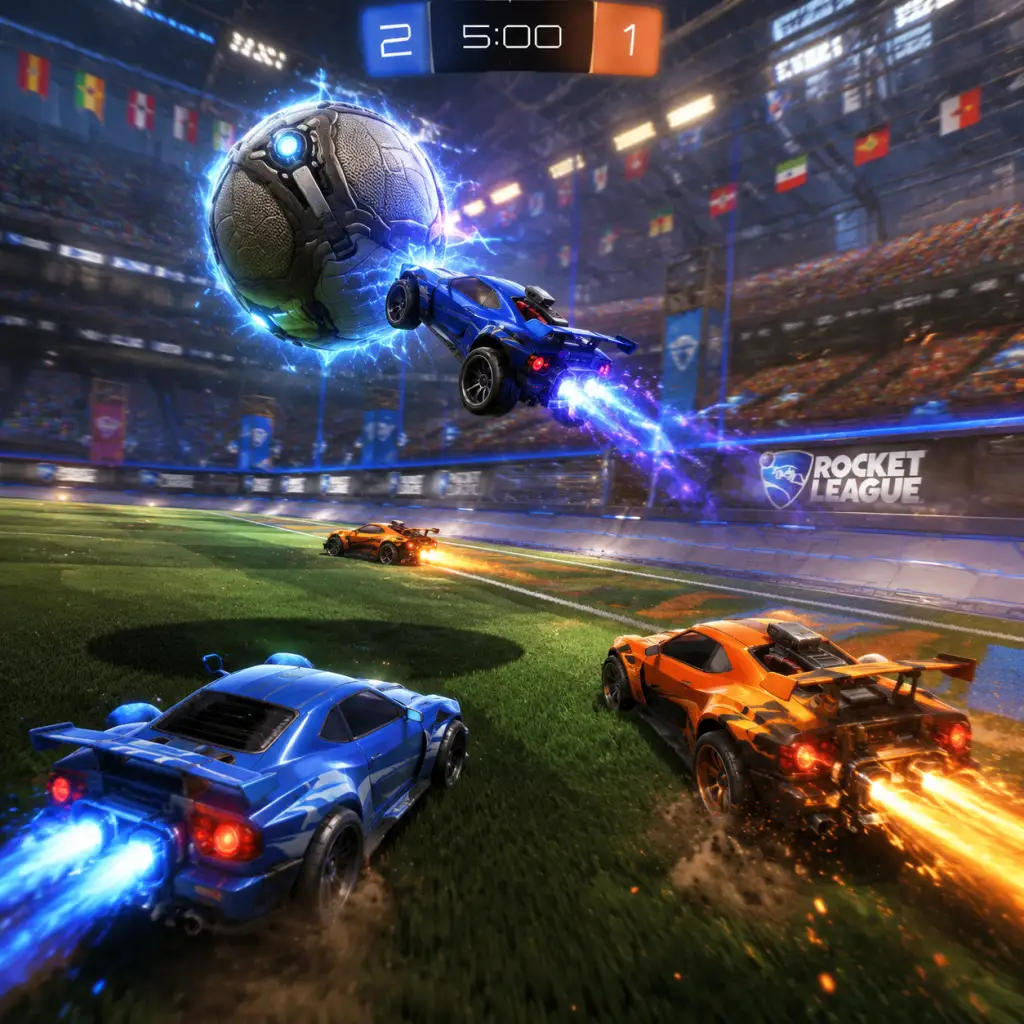
Rocket League combines arcade soccer with rocket-powered cars. Matches are 5-minute rounds where two teams (1v1, 2v2, 3v3, or extra modes) try to score a giant ball into the opponent's goal using car hits. The core loop: drive, boost, jump, dodge, and aerial to control the ball. Interaction is purely physical – no weapons or abilities – relying on car contact, demolition (hitting an opponent at supersonic speed), and bumping. Progression is account-based: player levels, Rocket Pass tiers, competitive skill rating (MMR). There is no open-world exploration; maps are closed arenas with unique layouts. Quests are replaced by daily/weekly challenges and seasonal events. Economy uses Credits (premium currency), Blueprints, and item trading. Character growth is cosmetic – car presets (body, decals, wheels, etc.) have no impact on performance except for certain hitbox types (Octane, Dominus, etc.) which affect feel. Endgame focuses on reaching high competitive ranks (Grand Champion, Supersonic Legend), mastering advanced mechanics, collecting rare items, and participating in tournaments.
Progression Tiers
Early Game (Levels 1–75 / Bronze–Silver Ranks)
Gameplay Loop: You learn basic controls: accelerate, brake, boost (B or circle), jump (A or X), dodge (double-tap jump + direction). Almost all time is on the ground. Matches feel chaotic; you chase the ball. Primary goal: make contact and drive toward goal.
Combat/Interaction: The only interactions are car-to-car bumps and light demos (rare at this level). Focus on hitting the ball rather than opponents. Boost management is critical – pick up small pads (12 boost) and big pads (100 boost) scattered on the field.
Progression: Each match grants XP toward account level. Daily wins (+1000 XP) and weekly tasks (+1500 XP) accelerate. Unlock free Rocket Pass items, drops (rare, very rare, import) that yield random cosmetics. Competitive rank starts after 10 placement matches. Early ranks (Bronze I to Silver III) are forgiving – you rarely derank until you reach Gold.
Exploration (Arenas): Only a few standard maps (DFH Stadium, Mannfield, etc.) plus the occasional non-standard map like Neo Tokyo or Utopia Coliseum (Retro). No exploration; you learn common kickoff spots and boost locations.
Quests/Missions: Daily and weekly challenges: “Score 5 goals”, “Play 3 matches in casual”, “Win 2 games in competitive”. Seasonal events (e.g., Frosty Fest) add limited-time challenges for themed items.
Economy: You earn free drops, occasional blueprints (pay-to-craft or trade). No need to spend Credits yet. Trading is unlocked at level 30 (formerly), but now account level 100+? Actually, trading requires XP level 100 (500+ wins) and 2FA. Early game: ignore trading, use default items.
Build Growth (Car Customization): Choose any car body; the most popular early choice is Octane (balanced handling). Hitbox presets: Octane (best all-round), Dominus (flatter for power shots), etc. No stat upgrades – only visual. Create presets with unlocked decals, wheels, toppers. Performance depends entirely on player skill.
Endgame Structure (not applicable in early game): None yet – focus on learning.
Mid Game (Levels 75–200 / Gold–Platinum Ranks)
Gameplay Loop: You understand rotation: attack, support, defend. Basic aerials (jump + boost + air roll) to hit aerial balls. Passing plays begin to work. Consistency improves: you can clear the ball, shoot on target, and save occasionally. Average match score: 1-3 goals per side.
Combat/Interaction: Demolitions become deliberate – supersonic boosts into opponents near goal. Bumps disrupt saves. You learn to avoid demos by jumping or dodging. The ball is contested in the air more often.
Progression: XP gain remains the same; Rocket Pass progression yields better items (painted, certified). Competitive ranks: Gold I to Platinum III. You start earning season rewards (wheels, decals) based on highest rank. Blueprints accumulate – you can trade them up (5 of same rarity for 1 higher) or craft with Credits. The trading economy becomes relevant: trade blueprints, drops, and items for Credits (platform-specific, not cross-platform). Use sites like RL Garage or RL Insider.
Exploration: You play more arenas including non-standard like Starbase Arc (with ramps) and Wasteland (odd shape). Learn each map’s boost placements and wall angles for dribbling.
Quests/Missions: Same daily/weekly challenges, but you can also complete ‘Season Challenges’ (110 challenges per season) for bigger rewards like goal explosions, wheels. Mid-game players finish most of these.
Economy: Credits are earned through Rocket Pass (free track gives 100 Credits per tier? No, free passes gave decryptors, now removed. Only Rocket Pass Premium gives Credits – 1000 Credits for pass, earn back up to 1000 Credits over tiers. So many players go infinite. You can also earn Credits by trading items from drops. The crafting cost for blueprints ranges from 100 (Very Rare) to 2000 (Black Market). Mid-game: trade up blueprints to Black Market, then sell for Credits to buy Rocket Pass.
Build Growth: You refine your preset. Octane is still king, but some switch to Dominus or Fennec for different flick power. No performance upgrades, but you may buy a specific item like a goal explosion or a painted body. At Platinum, some players use bakkesmod (PC only) for cosmetics but that’s not official.
Endgame Structure (preparation): You queue for tournaments (auto-generated brackets) that happen at scheduled times. Winning tournament matches gives titles and tournament items (untradeable). You also start focusing on specific training packs (e.g., aerial shots, redirects) to improve mechanics.
Late Game (Levels 200–500 / Diamond–Champion Ranks)
Gameplay Loop: High-paced aerial play. Fast aerials (jump + boost quickly) are standard. Air dribbles, ceiling shots, flip resets, and double-taps occur regularly. Rotations are tight: you trust teammates to rotate back after every touch. Passing plays use walls and backboard. Defences are strong – double commits are rare. Average score 2-4 goals per side.
Combat/Interaction: Demolitions are tactical: demo the goalkeeper before a teammate shoots, or clear the net for a pass. Bumps are used to disrupt dribblers. You also learn to “fake” challenges to force opponents to commit, then punish.
Progression: XP level matters less; focus is on rank. Diamond I to Champion III. Season rewards are better (painted wheels, animated decals). Rocket Pass premium is essential for all players to earn exclusive items and Credits (if you don’t trade). Trading is major: you may collect full sets of painted items (e.g., Octane set, Dieci wheel set). Engage with the trading community on Reddit (RocketLeagueExchange) or third-party sites. You might buy Credits at lower rates from traders (risky).
Exploration: All maps, including ‘Labs’ (non-standard) become familiar. You can choose game modes like Dropshot (floor breaks), Hoops (basketball), Snow Day (hockey puck) for variety. Competitive also has Extra Modes with their own ranks (Diamond in Snow Day, etc.).
Quests/Missions: Seasonal challenges from Rocket Pass are completed quickly. You may grind for specific tournament titles (e.g., “Diamond Tournament Winner”). Limited-time events like “Spring Fever” offer exclusive items.
Economy: Credits are accumulated. You may invest in high-value items (Black Market decals, Titanium White Octane) that hold value. Trading is the primary way to get specific items without opening loot boxes. Blueprints are often traded for Credits (e.g., 10-50 Credits per very rare, depending on item). Crafting is inefficient – only craft if you desperately want that item.
Build Growth: Car choice often narrows to Octane or Fennec (same hitbox) or occasionally Dominus. Customization is about showing skill and status – rare items signal dedication. You may use “Alpha Console” (PC) to test items but not in ranked. No build diversity; all cars with same hitbox are identical in performance.
Endgame Structure: You compete in tournaments regularly. Aim for “Champion” tournament winner title. You also start playing in “Rocket League Championship Series (RLCS)” qualifiers if you are high enough (Champion III+). Many players join Discord communities to find consistent teammates. Training routines become structured: 10-15 minutes of freeplay, 20 minutes of ranked, plus replay analysis.
Endgame (Grand Champion–Supersonic Legend / Levels 500+)
Gameplay Loop: Near-perfect mechanical execution and game sense. Every touch is purposeful: backboard clears, pass placements, demos on rotating players, prejumps. The game is incredibly fast – players can air dribble from anywhere, double tap from any angle. Rotations are split-second decisions. Goals come from punishing the slightest error.
Combat/Interaction: Demolitions are normalized – top players regularly demo opponents and avoid demos with advanced movement (air rolling to dodge). Bumps are used as part of defense (bumping the ball carrier off line). The few interactions that exist are fully mastered.
Progression: Rank is everything. Grand Champion (GC) has sub-tiers (I, II, III) and Supersonic Legend (SSL) is the highest – less than 0.5% of players. XP level is largely cosmetic (title). Rocket Pass items become common. Seasonal rewards are highly coveted (e.g., GC wheels). Trading: you own entire collections, maybe a full set of every painted apex wheel. Some players trade for real money (against ToS) but most use Credits.
Exploration: You know every boost location, every wall bounce angle, every map quirk (e.g., the glass on Mannfield night has a slight shine that can distract). No new content – you master existing.
Quests/Missions: Done trivially. You only care about special missions that give limited items (e.g., Golden Egg series). You may not even bother with casual challenges.
Economy: You have thousands of Credits. You attend “item showcase” servers. You rarely open crates; instead, you trade for specific items. The market dynamics matter – you follow price trends. You may “flip” items (buy low, sell high) for profit.
Build Growth: Car choice is min-maxed: most use Octane/Fennec, but some use Dominus for crisp flicks or Breakout for low profile. No stat variation. You customize with ultra-rare items (e.g., Striker-certified Titanium White Apex wheels, Gold Alpha Reward items that cost thousands of USD). Build is a status symbol.
Endgame Structure: Competitive is the core – you grind for SSL title each season. Tournaments: winning during the 2.5-hour windows gives exclusive titles (e.g., “RLCS X Grand Champion”). You may compete in third-party leagues like “The Brawl” or “Six Invitationals”. Content creation (YouTube, Twitch) is common. Some players go pro – salaries, orgs, RLCS LAN events. The ultimate endgame is reaching the top of the leaderboard (top 100). After that, it’s about maintaining rank, mastering new mechanics (e.g., “Musty flick”, “double flip reset”), and enjoying the community through coaching, creating training packs (e.g., “Aerial Car Control” by Poquito), or exploring Rocket League mods (PC custom maps like Lethamyr’s rings map).