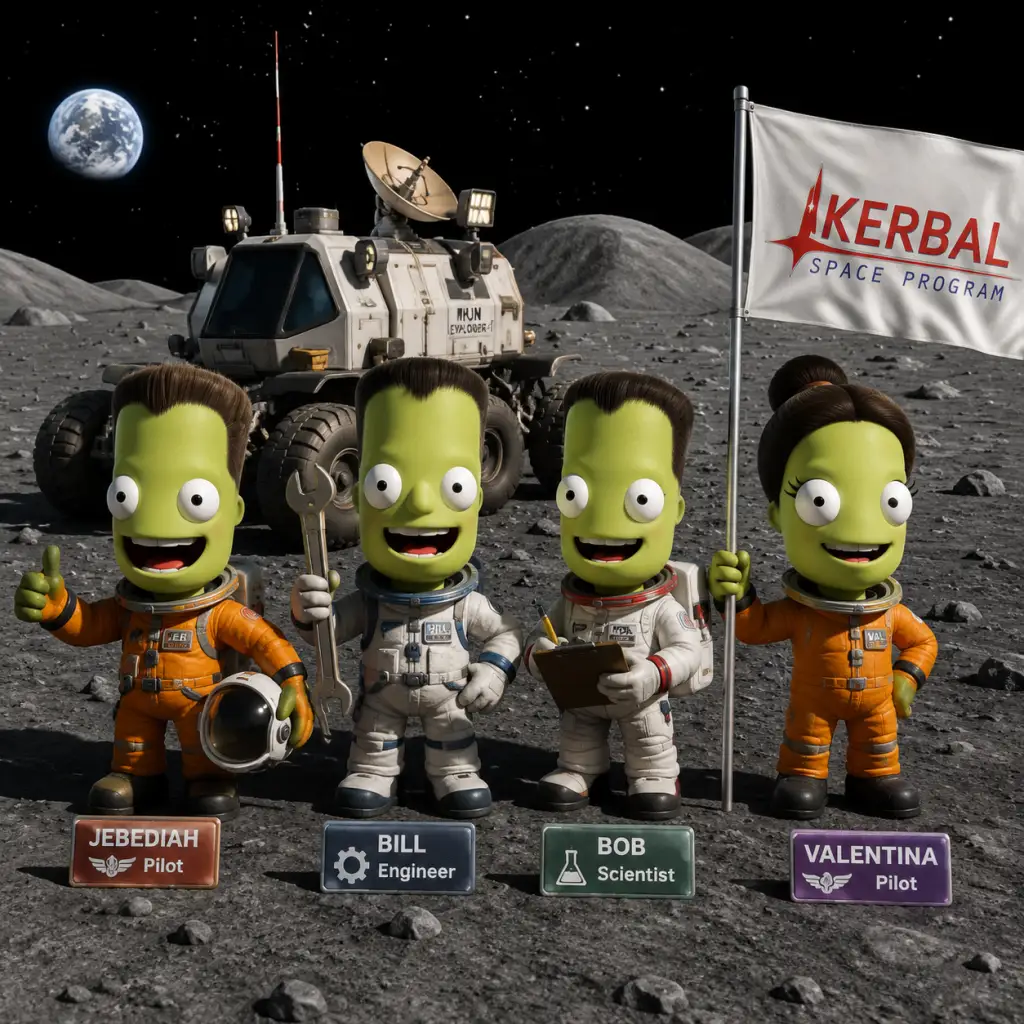
Characters & Roles
Characters & Roles in Kerbal Space Program
In Kerbal Space Program (KSP), your playable characters are the Kerbals—small, green, cheerful humanoid beings with an insatiable appetite for adventure. While they share a unified appearance, each Kerbal belongs to one of three distinct classes: Pilot, Engineer, and Scientist. These classes, combined with unique individual traits and experience levels, define how they contribute to missions. In Career mode, you can also encounter Tourists (non‑playable passengers) and Administrators (who provide global bonuses). This guide covers every playable Kerbal class, their backgrounds, strengths, weaknesses, recommended builds, and team synergies.
1. Overview of Kerbal Classes & Unlock Conditions
| Class | Primary Role | Unlock Condition (Career Mode) | Starting Availability |
|---|---|---|---|
| Pilot | Spacecraft control, stability assist | Available at start; can be hired from Astronaut Complex | Always present in Sandbox / Science mode |
| Engineer | Structural repairs, EVA construction, wheel/leg repairs | Available at start; hire from Astronaut Complex | Always present |
| Scientist | Experiment resetting, data collection, lab management | Available at start; hire from Astronaut Complex | Always present |
2. Pilot Class
Background: Pilots are the heart of any space program. They are trained to fly spacecraft with precision, perform complex maneuvers, and keep the crew calm under pressure. Notable Pilots include Jebediah Kerman (the iconic daredevil), Valentina Kerman (the first female Kerbal in orbit), and Bill Kerman (a calm, reliable pilot).
Strengths:
- Flight Control: Can activate SAS (Stability Assist System) without a probe core, saving weight and electricity.
- Maneuver Execution: At level 1+, Pilots can sas to target and hold prograde/retrograde automatically.
- Maneuver Node Assistance: At level 3+, they can execute precise node burns with higher accuracy.
- Re-entry Control: Pilots are less likely to panic during re-entry, reducing wobble.
- Cannot repair broken parts or perform scientific experiments.
- Useless on the surface without a command pod (no EVA science or construction).
- Low level Pilots have limited SAS modes.
- First‑time orbiters and interplanetary missions where manual control is critical.
- Spaceplanes and shuttles that require frequent attitude adjustments.
- Any mission where you want to save electricity by using crewed SAS instead of a reaction wheel module.
- Career mode contracts that demand a “Pilot” aboard.
- Available from the start in all modes.
- Hire cost: ~12,000 Kredits (Career).
- Experience levels gained by flying missions (e.g., achieving orbit, docking, landing on another body).
- Skill priority: Level up to unlock SAS modes: Level 0: Basic SAS (hold orientation). Level 1: Prograde/Retrograde hold. Level 2: Normal/Anti-normal. Level 3: Target‑relative modes. Level 4: Maneuver node auto‑execution.
- Equipment: A command pod with a good reaction wheel (e.g., Mk1-2 Command Pod) to complement SAS. For spaceplanes, pair with the Mk2 Cockpit.
- Traits: Daredevil (Jebediah) grants faster XP gain; Hardy reduces G‑force penalties.
- Works best with an Engineer to fix any structural damage from hard landings.
- A Scientist aboard can process data from experiments while the Pilot flies.
- For docking, a Pilot and Engineer can perform manual alignment while the Engineer repairs docking ports if misaligned.
- Experiment Resetting: Can reset certain experiments (e.g., Thermometer, Barometer, Seismometer) on EVA, allowing repeated use without needing multiple copies.
- Lab Operations: Can manage the Mobile Processing Lab MPL-LG-2, producing science points from data.
- Data Collection: Can collect and store experiment results from multiple biomes on EVA.
- Science Bonus: At higher levels, science output is multiplied (e.g., 2x at level 5).
- Cannot control spacecraft without a probe core (no SAS from piloting).
- Cannot repair broken parts or repack parachutes.
- Low level scientists cannot reset advanced experiments.
- Orbital missions around Mun/Minmus where you visit multiple biomes to gather surface samples and surface experiments.
- Deploying and operating the Mobile Processing Lab on a station or lander.
- Long‑duration missions where you need to grind science for the tech tree.
- Career contracts requiring a “Scientist” aboard.
- Available from start; hire for ~12,000 Kredits.
- Experience gained by performing experiments, processing data, and returning results.
- Skill priority: Level up to unlock experiment reset (Level 1). Higher levels increase data recovery multiplier.
- Equipment: Carry all science parts (Mystery Goo, Materials Bay, thermometers, etc.). A Science Jr. is essential for early career. For lab work, include the Mobile Processing Lab with ample electricity and living space.
- Traits: Perfectionist reduces cooldown on experiment reset; Observant gives a small science bonus.
- Pair with a Pilot to fly the craft while you science.
- An Engineer can extend solar panels or repair the lab if it gets damaged.
- For surface missions, bring both an Engineer and Scientist so the Engineer can set up a base that the Scientist uses for long‑term research.
- Repairs: Can repair broken solar panels, radiators, antennas, wheels (rover wheels), landing legs, and even repack parachutes on EVA.
- Construction: Can deploy EVA construction mode (with the Breaking Ground DLC) to attach/detach parts in space (level 1+).
- Wheel & Leg Enhancement: Higher levels improve the robustness of landing legs and rover wheels (less likely to break).
- Fuel Transfer: Can manually transfer fuel between tanks using EVA, though this is partly handled by stock mechanics.
- Cannot fly the spacecraft or process science experiments.
- Repair requires EVA time; insufficient EVA propellant can strand them.
- Cannot reset experiments.
- First‑time landings where you expect hard impacts (they can repair broken legs).
- Space stations and bases where you need to attach new modules via EVA construction.
- Rovers that might flip or break wheels on rough terrain.
- Repacking parachutes after a descent, allowing reusable landers.
- Career contracts requiring an “Engineer” aboard.
- Available from start; hire for ~12,000 Kredits.
- Experience gained by performing repairs, attaching parts via EVA construction, and surviving mishaps.
- Skill priority: Level 1 unlocks EVA construction (Essential for base building). Level 2+ improves wheel/leg durability. Level 5 grants the ability to repair heat shields and inflatable parts.
- Equipment: Always carry a KM‑KX‑S2 Fuel Pack (if using the Making History DLC) for EVA propellant. For construction, carry extra parts in cargo bays or use a Klaw (Advanced Grabbing Unit) to dock with debris. A Drill‑O‑Matic (Breaking Ground DLC) can harvest resources.
- Traits: Tough reduces repair time; Builder increases construction speed.
- Essential for any mission where damage is likely (e.g., atmospheric entry, rough landing).
- Pairs brilliantly with a Scientist on a mobile lab: the Scientist runs experiments, the Engineer fixes the lab if it overheats.
- With a Pilot, an Engineer can perform EVA construction while the Pilot maintains orientation.
Weaknesses:
Playstyle:
Pilots excel as the primary commander of crewed vessels. Use them for:
Unlock Conditions:
Recommended Equipment / Skill Build:
Team Synergy:
3. Scientist Class
Background: Scientists are the brains behind the operation. They analyze data from the Mun, Minmus, and beyond, unlocking new technologies. Famous Scientists include Wernher von Kerman (visionary rocket scientist), Melgee Kerman, and Katy Kerman.
Strengths:
Weaknesses:
Playstyle:
Scientist‑crewed vessels are ideal for science farming. Use them for:
Unlock Conditions:
Recommended Equipment / Skill Build:
Team Synergy:
4. Engineer Class
Background: Engineers are the tinkerers and repairers. They keep the spacecraft intact, build bases, and fix broken equipment. Notable Engineers include Bob Kerman (the quiet fixer), Kris Kerman, and Gretchen Kerman.
Strengths:
Weaknesses:
Playstyle:
Engineers are essential for complex, long‑duration missions. Use them for:
Unlock Conditions:
Recommended Equipment / Skill Build:
Team Synergy:
5. Notable Named Kerbals
While all Kerbals share the same class mechanics, certain named Kerbals have unique traits and backstories that affect gameplay in small ways:
| Name | Class | Unique Trait | Effect | Best Use Case |
|---|---|---|---|---|
| Jebediah Kerman | Pilot | Daredevil | +2 XP gain per mission, reduced G‑force tolerance penalty | Lead dangerous first‑time flights |
| Valentina Kerman | Pilot | Lucky | Slightly reduces chance of catastrophic failures (e.g., engine explosions) | Risky missions with low delta‑v margins |
| Bob Kerman | Engineer | Planner | Gives a 2% boost to all part efficiency (subtle) | Engineering teams building stations |
| Bill Kerman | Pilot | Steady | No panic during atmospheric flight | Spaceplane test flights |
| Wernher von Kerman | Scientist | Innovator | +5% science output from lab processing | Dedicated science stations |
| Katy Kerman | Scientist | Efficient | 10% reduction in experiment reset time | Fast science gathering on multiple biomes |
| Melgee Kerman | Scientist | Calm | No science penalty from G‑forces | High‑G reentry science missions |
| Kris Kerman | Engineer | Resourceful | Lowers construction part count by 1% (minor) | Base building with many struts |
6. Tourists & Administrators (Non‑Playable Roles)
Tourists: These are passengers with no skills; they cannot control anything or perform actions. They exist solely to fulfill contracts (e.g., “Fly a tourist to the Mun and back”). They take up crew capacity and require life support (if modded). Recommendation: Use empty crew cabins and treat them as dead weight. No special equipment needed.
Administrators: In Career mode, the Administration building allows you to assign a Kerbal administrator (e.g., Walt Kerman, Gus Kerman, Linus Kerman). Each provides a global bonus to your space program:
- Wally Kerman: +15% Kredits from contracts.
- Gus Kerman: +20% reputation gains.
- Linus Kerman: +10% science from experiments.
- …and others depending on DLC.
These are not playable units but can define your playstyle. Choose based on your goals: science rush (Linus), fund push (Wally), or reputation farming (Gus).
7. Team Composition & Synergy Strategies
| Mission Type | Recommended Team | Rationale |
|---|---|---|
| First orbiter | 1 Pilot (Jeb) | SAS saves weight; no repair needed |
| Mun landing (science) | 1 Pilot + 1 Scientist | Pilot flies, Scientist gathers data |
| Mun base construction | 1 Engineer (Bob) + 1 Scientist + 1 Pilot | Engineer builds, Scientist processes, Pilot flies modules |
| Interplanetary mission | 1 Pilot + 1 Scientist + 1 Engineer | Redundancy; engineer for mid‑course repairs, scientist for long‑term research |
| Space station operations | 1 Scientist (lab) + 1 Engineer (construction) + optional Pilot for logistics | Optimal for science and expansion |
| Rover mission | 1 Engineer (wheel repair) + 1 Pilot (drive) | Engineer keeps rover rolling |
| High‑risk rescue | 2 Pilots (extra SAS) + 1 Engineer (repair) | Pilot redundancy; Engineer fixes rescued vessel |
8. Experience, Leveling, and Skills
Each Kerbal gains experience as they “do things.” Here’s what earns XP:
- Any mission: +1 XP for achieving orbit, +2 XP for leaving Kerbin’s SoI, +3 XP for landing on another body, +5 XP for planting a flag.
- Specific actions: Performing an EVA repair (+1 XP), using a lab to produce data (+1 XP per batch), resetting experiments (+1 XP).
- Levels: Up to 5. Each level unlocks new abilities as described in the class sections.
- Pilot: Command pod with built‑in SAS (e.g., Mk1-2). Add a reaction wheel only if large vessel. Use ASAS module for extra stability during launch.
- Scientist: Equip all available science parts. Include a Mobile Processing Lab if doing orbital research. Add solar panels and batteries for lab power.
- Engineer: Carry EVA propellant packs (extra fuel on suit). For EVA construction, bring spare parts in cargo bays or use a Klaw to manipulate debris. Include Drills and Convert‑O‑Tron if building refueling bases.
- Use the Astronaut Complex: In Career, hire Kerbals early. A second Pilot and Engineer are cheap insurance.
- Don’t neglect low‑level Kerbals: Send them on simple suborbital hops to grind XP before complex missions.
- Mix classes for synergy: A Pilot + Engineer team can perform orbital assembly of a large interplanetary ship.
- Remember permadeath: Quickload if a Kerbal dies in Career (unless you want the drama).
- Tourists are not playable: They just take seats; you can ignore their lack of skills.
Recommendation: Focus on leveling up a core team of 3–4 Kerbals early by sending them on repeated short missions. Avoid killing them (permadeath in Career); losing a high‑level Kerbal is costly.
9. Equipment & Build Recommendations per Class (Summary)
10. Final Tips
With this guide, you understand every playable character in KSP and how to maximize their potential. Assemble the right team, respect their roles, and the stars are yours!