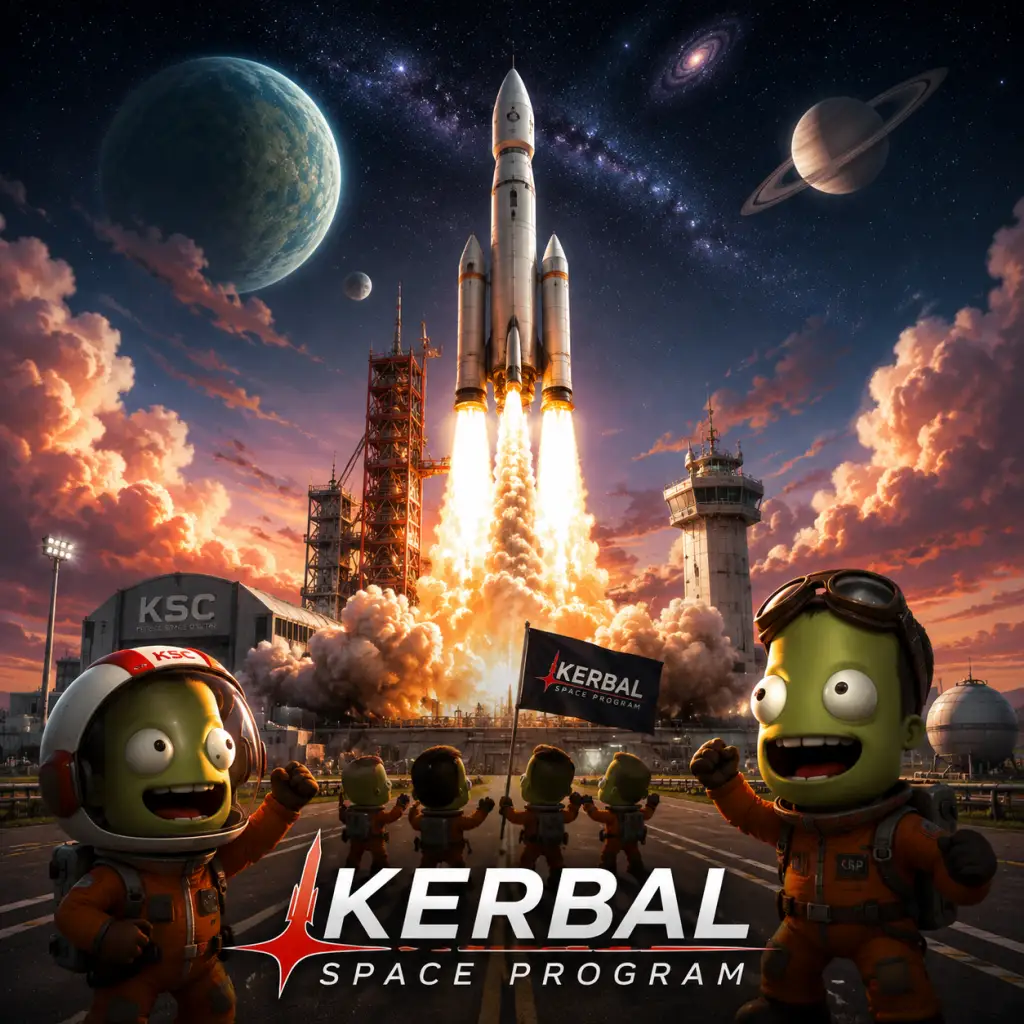
Game Introduction
Kerbal Space Program – Game Introduction
Overview
Kerbal Space Program (KSP) is a critically acclaimed space flight simulation and sandbox game developed by Squad and published by Private Division. It first entered Early Access on June 24, 2011, and officially launched version 1.0 on April 27, 2015. The game is available on PC (Windows, macOS, Linux), PlayStation 4, Xbox One, and Nintendo Switch (via the Enhanced Edition). Mobile versions are not officially supported.
Genre & Core Appeal
KSP blends simulation, sandbox, and strategy genres. Its core appeal lies in the realistic orbital physics (powered by the patched-conic approximation) combined with a whimsical, cartoonish aesthetic. Players build and fly rockets, spacecraft, and aircraft using a modular part system, then manage a space program with limited resources. The game rewards creativity, problem-solving, and patience, often with spectacular (and hilarious) failures.
Setting & Story
KSP has no traditional narrative; instead, it offers a player-driven story set in a fictional solar system called the Kerbol System. The system includes the star Kerbol, the home planet Kerbin (analogous to Earth), and its moon Mün, plus other planets and moons like Duna (Mars), Eve (Venus), Jool (Jupiter analog with multiple moons), and more. The titular Kerbals are small, green, cheerful humanoid creatures with a knack for building and exploring. Prominent Kerbals include Jebediah Kerman (brave/cocky), Valentina Kerman (first female Kerbal), Bill Kerman (nerdy), and Bob Kerman (scientist). While they have minimal characterization, their exaggerated reactions and names add charm. The “story” you create might be landing a Kerbal on the Mün, establishing a space station, or launching an interplanetary mission, with every triumph or disaster forming your own unique narrative.
Main Characters
- Jebediah Kerman – The iconic pilot with a goofy grin; often the first Kerbal players send to space.
- Valentina Kerman – The first female Kerbal added in version 0.24; represents the program’s diversity.
- Bill Kerman – The engineer; prone to nervousness but skilled.
- Bob Kerman – The scientist; frequently seen as a passenger for experiments.
- Numerous other procedurally generated Kerbals join the program as you hire them.
- Sandbox – Unlimited parts, unlimited funds, no research. Pure creative freedom.
- Science Mode – Earn science points by performing experiments in different biomes and altitudes to unlock new parts. No monetary constraints.
- Career Mode – Full simulation: manage funds, research tech tree, build contracts, and hire Kerbals. Failures can bankrupt the program.
- Realistic Physics Simulation – The game uses a simplified but convincing orbital mechanics model. Achieving orbit requires understanding thrust, delta-v, and gravity turns, making it a genuine learning tool for spaceflight.
- Sandbox Creativity – With hundreds of parts (fuel tanks, engines, structural pieces, etc.), players can build anything from simple rockets to complex rovers, spaceplanes, or even replicas of real spacecraft.
- Hilarious Failure – Crashes, explosions, Kerbal reactions, and unintended disassemblies are part of the charm. The game encourages experimentation without punishing failure too harshly.
- Educational Value – Many schools use KSP to teach physics, mathematics, and engineering principles.
- Modding Community – An enormous library of mods extends gameplay with new parts, visual enhancements, life support systems, and even full solar system overhauls.
- Space enthusiasts and amateur astronomers
- Gamers who enjoy creative sandboxes (like Minecraft or Besiege)
- Physics and engineering hobbyists
- Players with patience for trial-and-error learning
- Suitable for teens and older due to complexity (rated E for Everyone by ESRB)
Game Modes
Players can choose from three primary modes:
Additionally, a Tutorial Mode guides beginners through basic concepts like building rockets, achieving orbit, and docking.
Online/Offline Support
KSP is primarily an offline single-player experience. There is no official multiplayer or online mode. However, the community has developed mods like DMP (Dark MultiPlayer) for unofficial multiplayer. The game includes a physics warp feature for fast-forwarding time locally.
DLC & Expansions
Two major expansion packs add content:
1. Making History (released March 2018) – Adds a mission builder, historical rocket parts (e.g., Saturn V ), and new launch sites.
2. Breaking Ground (released May 2019) – Introduces robotic parts (hinges, pistons, rotors), deployable science experiments, and surface features like craters and geysers that can be scanned.
Both DLCs integrate seamlessly into all game modes.
What Makes KSP Unique
Target Audience
KSP appeals to a broad audience:
Summary
Kerbal Space Program is more than a game; it’s a physics playground where the journey matters as much as the destination. Whether you’re launching your first wobbly rocket or executing a precise transfer to Jool, KSP offers infinite replayability and a unique blend of education and entertainment. Buckle up, recruit some green astronauts, and reach for the stars.