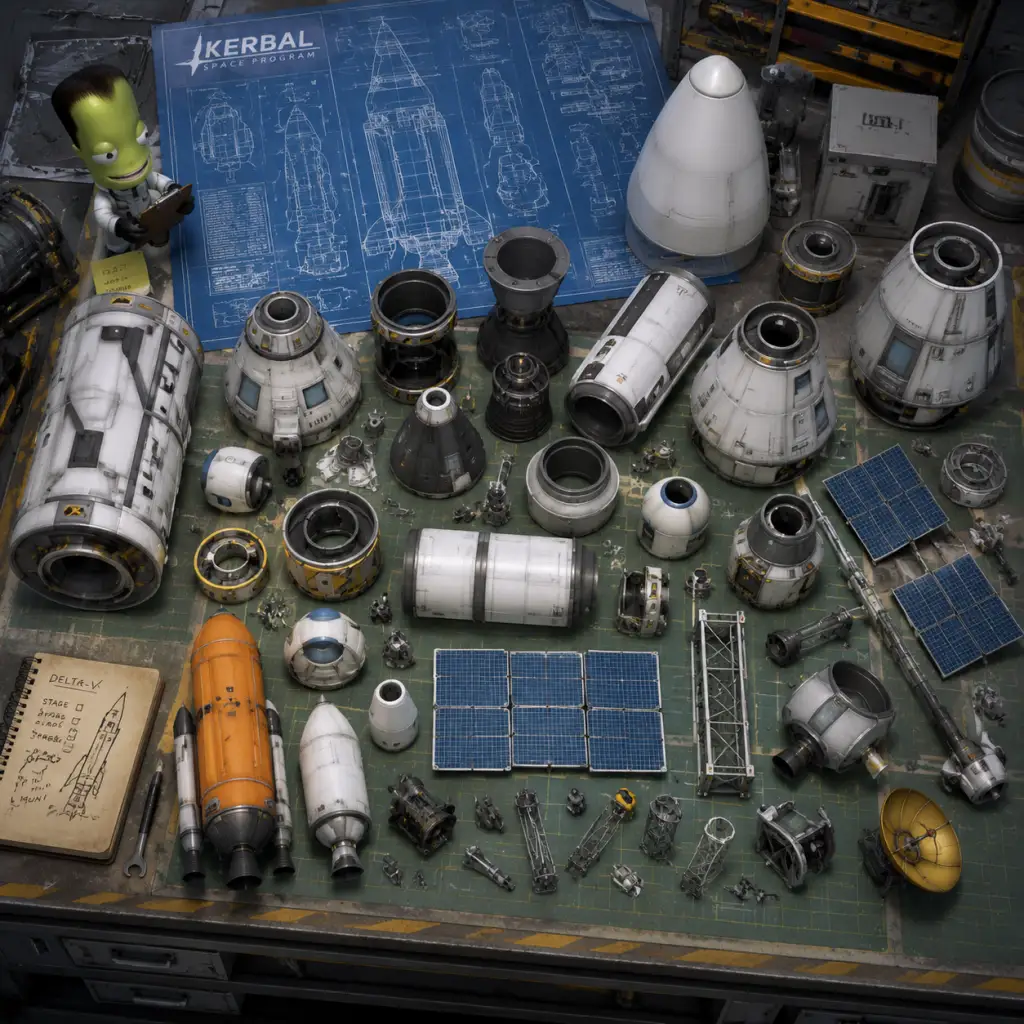
All Game Items
All Game Items in Kerbal Space Program
Kerbal Space Program (KSP) does not include traditional weapons, armor, or typical RPG currencies. Instead, the game revolves around constructing rockets, spacecraft, and bases using a vast catalog of parts, managing resources, and conducting science. This guide categorizes all major items—parts, resources, science equipment, collectibles, and special modules—with explanations on how to unlock, obtain, and effectively use them.
1. Core Resource Items
Resources are consumed or produced during missions. They are stored in tanks and transferred between vessels.
#### 1.1 Liquid Fuel & Oxidizer
- Description: The primary propellant for most rocket engines. Liquid Fuel (LF) and Oxidizer are stored in combined or separate tanks.
- How to Obtain: Unlocked via the tech tree (e.g., Basic Rocketry, General Rocketry). Purchased in the Vehicle Assembly Building (VAB) or Spaceplane Hangar (SPH) as part of a fuel tank part.
- When Useful: Every launch, orbital maneuver, and interplanetary transfer.
- Synergies: Used by liquid fuel engines (e.g., LV-T30, Swivel). Pair with engine-specific performance (Isp, thrust) for optimum delta-v.
- Description: Used by RCS (Reaction Control System) thrusters for fine attitude control and translation.
- How to Obtain: Unlocked via tech (e.g., Precision Propulsion). Stored in dedicated monopropellant tanks.
- When Useful: Docking, landing on small bodies, precise maneuvers.
- Synergies: RCS blocks (e.g., Place-Anywhere 7, Linear RCS) consume monopropellant. More efficient than reaction wheels for translation.
- Description: Propellant for ion engines – highly efficient but low thrust.
- How to Obtain: Unlocked via tech (e.g., Ion Propulsion). Stored in spherical Xenon containers.
- When Useful: Long-duration missions (e.g., interplanetary probes, rovers). Requires patience due to low thrust.
- Synergies: Used exclusively with the PB-ION Electric Propulsion System and Dawn ion engine (Breaking Ground DLC). Pair with solar panels or RTGs for power.
- Description: Power for avionics, reaction wheels, lights, and science instruments. Measured in ElectricCharge units (EC).
- How to Obtain: Generated by solar panels, RTGs (Radioisotope Thermoelectric Generators), fuel cells. Stored in batteries.
- When Useful: Always needed for active control and communication. Critical during eclipses or distant from Sun.
- Synergies: High-power antennas and ion engines drain large amounts. Use multiple solar panels or RTGs for deep space.
- Description: Raw material for the Convert-O-Tron to produce Liquid Fuel, Oxidizer, and Monopropellant. Found on planetary surfaces via drills.
- How to Obtain: Drill equipped with an ore tank. Available via tech (e.g., Mining, Advanced Metalworks).
- When Useful: In-situ resource utilization (ISRU) for refueling bases or landers.
- Synergies: Requires drills, ore tanks, and Convert-O-Tron. Fuel cells can convert Ore and ElectricCharge to power.
- Description: Consumed by heat shields during atmospheric reentry to dissipate heat.
- How to Obtain: Integrated into heat shield parts (e.g., Heat Shield 1.25m, 2.5m).
- When Useful: Returning from orbit or interplanetary travel; preventing overheating on craft.
- Synergies: Use with a heat shield and ensure ablator quantity matches reentry speed. Pair with parachutes for landing.
- Description: Containers for Kerbals or probes. Provide control, SAS, and crew capacity.
- Types:
- How to Obtain: Early tech: Start, Basic Rocketry, etc. Larger pods later.
- When Useful: Essential for any manned or unmanned mission. Choose based on crew capacity and mass.
- Synergies: Pair with reaction wheels for better SAS. For probe cores, ensure enough battery and antenna for communication.
- Description: Convert propellant into thrust. Categories: Liquid Fuel, Solid Fuel, Ion, Nuclear.
- Key Examples:
- How to Obtain: Unlock via tech nodes like General Rocketry, Propulsion Systems, Nuclear Propulsion.
- When Useful: Each engine excels in a specific environment (atmosphere, vacuum) or role (booster, upper stage, lander).
- Synergies: Match engine Isp with atmospheric pressure. Use multiple engines for heavy lift. Combine with fuel tank sizes for desired thrust-to-weight ratio.
- Description: Store propellant (LF/O, Monopropellant, Xenon, Ore).
- Variants: Various diameters (0.625m, 1.25m, 2.5m, 3.75m) and shapes (cylindrical, spherical, structural).
- How to Obtain: Unlocked alongside engines or through tech (e.g., Fuel Systems, Heavy Rocketry).
- When Useful: Every craft. Select tank size to fit engine and mission delta-v requirements.
- Synergies: Stack tanks in series; use radial tanks for extra capacity. Lightweight tanks improve mass ratio.
- Description: Connectors, struts, fairings, adapters, and girders to build custom shapes.
- Examples: Cubic Octagonal Strut, TR-18A Stack Decoupler, Modular Girder Adapter.
- How to Obtain: Unlocked via tech (e.g., General Construction, Advanced Construction).
- When Useful: Reducing part count, transferring loads, attaching side boosters, fairing payloads.
- Synergies: Use struts to prevent wobbling in large builds. Fairings protect payload from aerodynamic drag.
- Description: Nose cones, wings, control surfaces, and air intakes for atmospheric flight.
- Examples: Nose Cone, Delta Wing, Elevon 1, Advanced Nose Cone (Breaking Ground).
- How to Obtain: Unlocked via tech like Aerodynamics, Supersonic Flight.
- When Useful: Reducing drag on launch; controlling airbreathing stages; building spaceplanes.
- Synergies: Wing area affects lift. Control surfaces provide pitch/roll/yaw during atmospheric flight. Pair with air-breathing engines for early ascent.
- Decouplers: Separate stages (e.g., TT-38K Radial Decoupler, TR-2V Stack Decoupler).
- Docking Ports: Allow docking two vessels (e.g., Clamp-O-Tron Sr., Jr.).
- How to Obtain: Early tech (Stage Separation, General Construction) for decouplers; later (Advanced Docking) for ports.
- When Useful: Essential for staging, assembling space stations, refueling, and crew transfers.
- Synergies: Combine decouplers with sepatrons for safe separation. Docking ports require precise alignment and RCS.
- Description: Instruments to gather scientific data from experiments.
- Major Items:
- How to Obtain: Unlock via science-focused tech nodes (e.g., Basic Science, Advanced Science).
- When Useful: Every mission to gain science points (Career/Science mode). Use different experiments in biomes or at high/low altitude.
- Synergies: Combine with a mobile processing lab to transmit data multiple times. Return experiments to Kerbin for maximum science yield.
- Description: Enable communication link to Kerbin (required in some modes with CommNet).
- Types:
- How to Obtain: Unlock via tech (e.g., Advanced Electrics, Large Electrics).
- When Useful: Essential for controlling unmanned probes (requires CommNet signal). Relay antennas extend network.
- Synergies: Multiple antennas can combine. Directional antennas require pointing; deployable antennas save space.
- Solar Panels: Convert sunlight to EC (e.g., OX-4B, Gigantor XL).
- RTGs: Generate EC constantly (e.g., PB-NUK, Breaking Ground RTG).
- Fuel Cells: Convert LFO into EC + heat (e.g., Fuel Cell Array).
- Batteries: Store EC (e.g., Z-100, RC-001S).
- How to Obtain: Tech nodes: Basic Electrics, Advanced Electrics, Nuclear Power.
- When Useful: Every vessel needs power. Solar panels are best near Kerbin; RTGs for deep space.
- Synergies: Batteries act as buffer for peak loads. Fuel cells can also produce water (with mods or DLC).
- Wheels: For rovers (e.g., RoveMax Model S2, TR-2L).
- Landing Legs: For stable landings (e.g., LT-1, LT-5).
- How to Obtain: Tech like Landing, Field Science.
- When Useful: Landing on planets; exploring surfaces with rovers.
- Synergies: Use landing legs on landers; wheels need suspension for rough terrain.
- Reaction Wheels: Provide torque for attitude control (e.g., Inline Reaction Wheel, SAS).
- RCS Thrusters: Use monopropellant (e.g., RV-105 RCS, Place-Anywhere 7).
- How to Obtain: Tech: Precision Propulsion, Advanced Flight Control.
- When Useful: Maneuvering without main engines; docking; stabilizing large vessels.
- Synergies: Reaction wheels need EC. RCS is essential for translation. Combine both for best control.
- Cargo Bays: Hold payloads inside aircraft/spaceplanes (e.g., Mk3 Cargo Bay, Mk2 Cargo Bay).
- EVA Jetpack: Used by Kerbals during spacewalks for small thrust.
- Ladders: Allow Kerbals to climb (e.g., Telescopic Ladder).
- How to Obtain: Via tech (e.g., Spaceplane parts for cargo bays; EVA items default, but better jetpacks via EVA Propulsion).
- When Useful: Transporting rovers, satellites; Kerbals collecting surface samples.
- Breaking Ground: Adds robotic parts (hinges, pistons, rotors, servos), deployable science parts (e.g., Surface Experiment Package, Weather Station), and propellers.
- Making History: Adds historical parts (e.g., Soviet-style nose cones, 2.5m fairings, new engines like the Wolfhound), mission builder props.
- Obtaining: DLC purchased separately. Parts appear in VAB.
- Usefulness: Robotics allow moving parts, folding wings, drills. Propellers enable atmospheric flight without rockets. Surface experiments add long-term science.
- Synergies: Robotics can automate solar panel deployment, rover arms. Combine with KAL-1000 controller for sequences.
- Description: Generated by experiments (crew reports, EVA reports, surface samples, etc.). Can be transmitted (partial science) or recovered (full value).
- How to Obtain: Perform experiments in flight/on surface.
- When Useful: Unlock tech tree in Career/Science mode.
- Synergies: Use a Mobile Processing Lab to convert data into more science points. Transmit high-value experiments (e.g., goo, sci jr) from remote locations.
- Description: Plantable flags on celestial bodies to mark achievements.
- How to Obtain: Crafted in VAB/SPH under 'Flags' tab; also available as a part.
- When Useful: Tradition upon first landing; can be placed via EVA.
- Synergies: None gameplay-wise, but provide a sense of accomplishment.
- Surface Samples: Collected by Kerbals on EVA. Highly valuable science.
- Crew/EVA Reports: Small science from command pod or Kerbal.
- When Useful: Early science gains; biome-specific.
- Description: Money used in Career mode to buy parts and vessel costs.
- How to Obtain: Completing contracts, recovering vessels, world firsts.
- When Useful: Purchase new parts at the start; upgrade buildings.
- Synergies: Build efficient, reusable rockets to save costs. Accept lucrative contracts.
- Description: Points to unlock tech tree nodes.
- How to Obtain: Recovering or transmitting science experiments; world firsts.
- When Useful: Progressing through tech tree.
- Synergies: Prioritize high-value experiments (surface samples, goo, materials bay). Use mobile lab to double research.
- Description: Public image affecting contract rewards and new contract types.
- How to Obtain: Completing contracts (especially world firsts, milestones). Lose reputation from failures.
- When Useful: Unlock better contracts (e.g., exploration, satellite networks).
- Synergies: Maintain high reputation for lucrative offers.
- Description: Small amount of monopropellant in Kerbals' EVA jetpacks.
- How to Obtain: Default with Kerbal; refilled by entering command pod or using a dedicated part.
- When Useful: Spacewalks, moving between docked ships, rescues.
- Synergies: Manage propellant carefully; use only for small corrections.
- Note: Vanilla KSP has no life support. Mods add food, water, oxygen.
- Training: In Career mode, Kerbals gain experience levels (Pilot, Engineer, Scientist) improving SAS, repair, science yields.
- How to Obtain: Recruited from Astronaut Complex; can rescue stranded Kerbals via contracts.
- Usefulness: Each has unique skills: Pilots enable SAS stability, Engineers repair wheels and struts, Scientists boost science experiments.
- Synergies: Assign appropriate Kerbal to role: Pilot on crewed capsule, Scientist on lab, Engineer on rover/station.
- Delta-V (Δv) is the single most important metric: sum of Isp × g0 × ln(mass_fueled / mass_dry).
- TWR (Thrust-to-Weight Ratio) must be >1 to lift off Kerbin (ideal ~1.2-1.5).
- Engine Clustering: Use multiple small engines for redundancy but higher part count.
- Staging: Decouple empty tanks to reduce mass; asparagus staging increases efficiency.
- Heat Management: Radiator panels prevent overheating from engines/atmosphere.
- CommNet: Antenna strength and range; relay network for far planets.
- ISRU Loop: Drill → Ore tank → Convert-O-Tron → LFO/Mono → tank → engine.
- Tech Level: Higher-tier parts (e.g., Poodle, Mammoth) have better Isp, thrust, or efficiency. Unlock via deeper tech nodes.
- Upgrade via Building Upgrades: In Career, upgrading VAB, Launch Pad, R&D, etc., unlocks larger part limits, higher thrust limits, and more complex actions.
- DLC Parts: Making History adds high-performance engines like Wolfhound (high Isp, low thrust) suitable for upper stages. Breaking Ground robotics allow movable science arms, solar panel deployers.
#### 1.2 Monopropellant
#### 1.3 Xenon Gas
#### 1.4 Electric Charge
#### 1.5 Ore
#### 1.6 Ablator (Heat Shield Resource)
2. Spacecraft Parts (Components)
Parts are the building blocks of any vessel. They are unlocked through the tech tree and purchased with in-game Kerbal currency (Funds) in Career mode. In Science mode, they are unlocked via science points; in Sandbox, all are available.
#### 2.1 Command Modules
- Mk1 Command Pod: Single-Kerbal, basic control.
- Mk1-2 Command Pod: Three-Kerbal, advanced SAS.
- Mk2 Lander Can: Two-Kerbal, low profile for landers.
- Probodobodyne RoveMate: Probe core for rovers (no crew).
#### 2.2 Engines
- LV-T30 Liquid Fuel Engine: Powerful, no gimbal, early game.
- LV-909 Terrier: Vacuum-optimized, efficient for upper stages.
- LV-N Atomic Rocket Motor: Nuclear thermal engine, high Isp in vacuum, heavy.
- RT-10 Solid Fuel Booster: High thrust, simple staging, no throttle.
- PB-ION Dawn Ion Engine: Low thrust, high Isp, long burns.
#### 2.3 Fuel Tanks
#### 2.4 Structural Parts
#### 2.5 Aerodynamic Parts
#### 2.6 Decouplers & Docking Systems
#### 2.7 Science Equipment
- Mystery Goo Containment Unit: Measures goo behavior; returns goo observation.
- Science Jr. (Material Bay): Analyzes material samples.
- Thermometer: Measures temperature.
- Barometer: Measures pressure.
- Gravioli Detector: Measures gravity.
- Accelerometer: Measures acceleration.
- SC-9001 Science Jr.: Upgraded material bay.
- PresMat Barometer: Advanced barometer.
- Spectrometer: Analyzes light spectrum.
- Multispectral Imaging Platform: High-res imaging.
- Atmospheric Fluid Spectro-Variometer: Measures atmospheric composition.
#### 2.8 Communication & Antennae
- Communicatron 16-S: Short range, low power.
- HG-5 High Gain Antenna: Medium range.
- RA-2 Relay Antenna: Long range, can relay.
- DTS-M1: Short-directional.
#### 2.9 Power Generation & Storage
#### 2.10 Landing Gear & Rovers
#### 2.11 Propulsion-Related (RCS, Reaction Wheels)
#### 2.12 Cargo & Kerbal Equipment
#### 2.13 Special DLC Items (Breaking Ground, Making History)
3. Science & Collectibles
#### 3.1 Science Reports & Data
#### 3.2 Flags
#### 3.3 Surface Samples & Astronaut Reports
4. Currency & Progression Items
#### 4.1 Funds (Kerbal Currency)
#### 4.2 Science Points
#### 4.3 Reputation
5. Consumables & Kerbal Items
#### 5.1 EVA Propellant (Jetpack Fuel)
#### 5.2 Ablator (already covered)
#### 5.3 Life Support
#### 5.4 Kerbals (Crew)
6. Important Part Upgrade & Synergy Concepts
7. Part Quality Tiers & Upgrades
8. Summary Table of Key Resource Tanks
| Resource | Storage Part Examples | Best Used For |
|---|---|---|
| LF/O | FL-T800, Jumbo-64 | Rocket stages |
| Monoprop | Stratus-V, Mk2 Monoprop | RCS systems |
| Xenon | PB-X150, X200-16 | Ion propulsion |
| Ore | Small Ore Tank, Large Ore Tank | ISRU mining |
| Electric | Z-400, RC-001S | Power buffer |
Conclusion
This guide covers all major items in Kerbal Space Program. Unlike action games, KSP's "items" are parts and resources that you combine to overcome physics. Understanding each part's purpose and synergy is key to efficient rocket design. Always consider the mission environment (atmo vs vacuum) and plan for power, control, and communication. With practice, you'll master the game's inventory of over 200 parts and build anything from a simple suborbital hopper to an interstellar colony.