Core Gameplay
Core Gameplay Overview
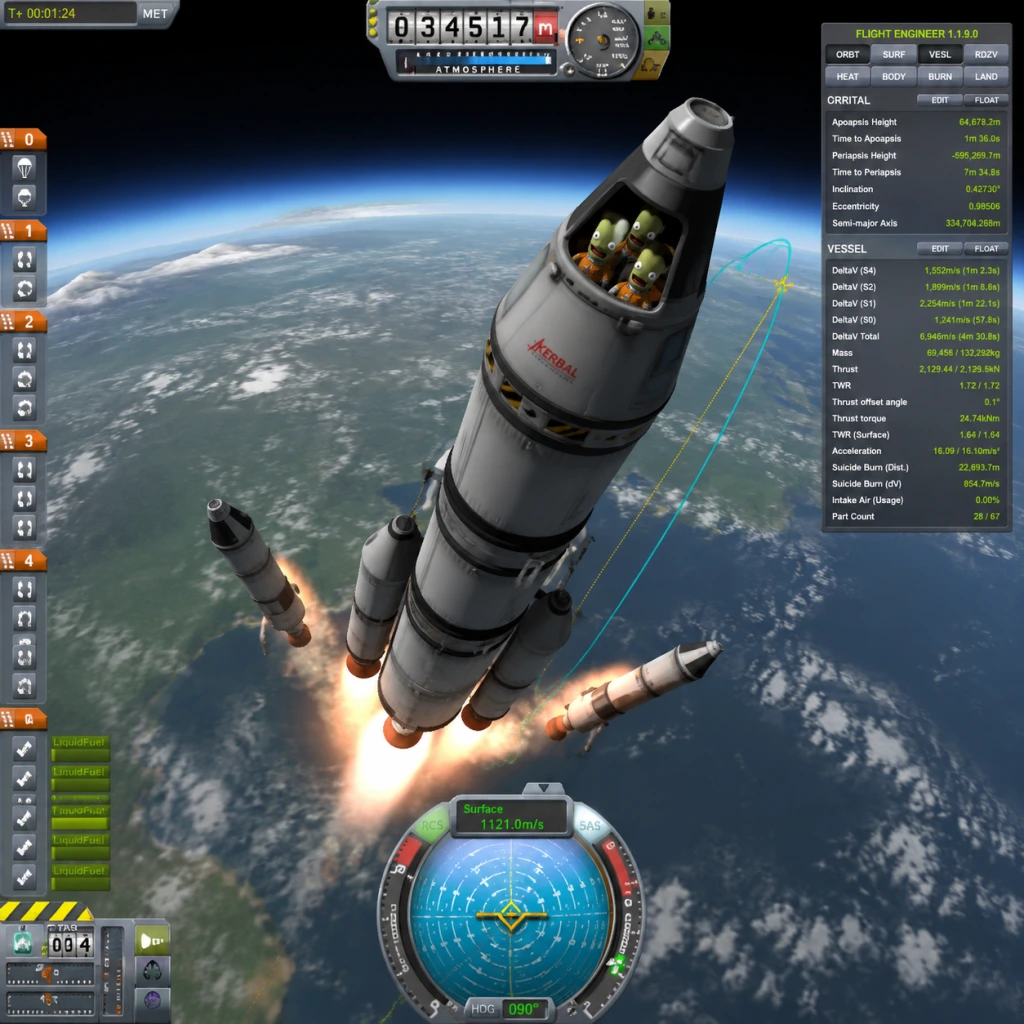
Kerbal Space Program (KSP) is a physics-based space flight simulation where you design, build, and fly spacecraft for the Kerbals—a cheerful, green-skinned species. The core gameplay loop revolves around the engineering process: design → build → test → iterate. Instead of combat, the game features environmental challenges (orbital mechanics, fuel management, re-entry heat) and a robust career mode that acts as a mission system. There is no combat or hostile NPCs; the primary “interaction” is with celestial bodies and the game’s realistic orbital physics. Progression is unlocked through Technology, Funds, Reputation, and building upgrades. This guide breaks down the gameplay into four distinct tiers based on player progression.
Player Progression Tiers
---
Early Game (Tier 1)
Goal: Achieve Kerbin orbit and return safely. Understand basic rocket design and atmospheric flight.
Gameplay Loop:
1. Accept simple contracts (e.g., “Launch a vessel to 10 km,” “Test a part at the launch pad”).
2. Use pre-built rockets or design simple two-stage rockets with liquid fuel engines and a small command pod.
3. Launch, stage, and control ascent to reach low Kerbin orbit (70-100 km).
4. Perform a de-orbit burn and re-enter, deploying parachutes for landing.
5. Recover the vessel to gain Funds and Reputation.
Progression:
- Tech Tree: Start with basic node “Start” (Mk1 Pod, RT-10 Booster, basic fins). Earn Science points by performing crew reports, EVA reports, and surface samples in different biomes (Launch Pad, Grasslands, Water).
- Building Upgrades: The Vehicle Assembly Building (VAB) and Launch Pad start at level 1, limiting part count (~30 parts). Upgrade with Funds.
- Funds & Reputation: Earned through contract completion. Early contracts reward small amounts; focus on “first flight” and “crew report” missions.
- World’s First Contracts: “Fly a vessel”, “Reach space” (>70 km), “Orbit Kerbin”.
- Part Testing: Use specific parts in certain situations (e.g., “Test the LV-T30 engine while splashed down”).
- Crew Reports: Perform experiments in various biomes.
- Funds are the primary currency. Spent on building new parts, upgrading buildings, and paying for vessel recovery (cost is 100% recovered if vessel is not destroyed).
- Strategy: Avoid overly expensive designs; recover everything. Use Boosters wisely to reduce cost.
- Kerbal Experience: Each Kerbal gains experience from missions. Levels unlock Green (0), Regular (1), Veteran (2), Elite (3), Badass (4). Higher levels increase stability, science collection rates, and allow special actions like repairing wheels. Early game, you only have Jebediah, Bill, Bob, and Valentina. Keep them alive – death is permanent in Career mode.
- Build Skills: Learn to design stable rockets with enough thrust-to-weight ratio (TWR > 1.5 on launch) and adequate delta-v (~3,400 m/s for orbit). Use action groups and staging.
- Poorly designed rockets flip or explode.
- Running out of fuel or electricity.
- Re-entry overheating without heat shield.
- Tech Tree: Key nodes: Flight Control (improves SAS/stability), Space Exploration (LV-909 engine), Heavy Rocketry (Skiff engine), Landing (advanced landing legs). Unlock batteries, solar panels, retractable solar panels.
- Building Upgrades: Level 2 VAB (part limit 255), Level 2 Launch Pad (max mass 250t), Level 2 Tracking Station (can view encounters), Level 2 Mission Control (more contracts).
- Contracts become more varied: “Explore the Mun,” “Plant a flag on Minmus,” “Test part in orbit of Mun.”
- Mun: Medium gravity (1.63 m/s²), no atmosphere. Landing requires careful suicide burn (~580 m/s delta-v from low orbit). Biomes: Highlands, Midlands, Lowlands, Poles, Farside Crater.
- Minmus: Low gravity (0.49 m/s²), flat plains make landing easy. High science returns from Flats biomes (especially the “Great Flats”).
- Interplanetary: Duna is reachable with a transfer window (~90° angle). Eve is extremely difficult to return from. Probes are cheaper and risk-free for Kerbals.
- World’s First: “Land on the Mun”, “Return from the Mun”, “Orbit Minmus”.
- Satellite Contracts: Deploy a satellite in specific orbit around Mun/Minmus/Kerbin.
- Survey Contracts: Take temperature, atmosphere readings over certain locations.
- Turf that stage: “Perform a crew report while flying low over Mun’s surface”.
- Funds become tighter if you lose expensive craft. Recover everything. Sell unwanted parts (reimburse 50% when recovering a vessel).
- Strategies: Use reusable landers (recover on Kerbin). Combine multiple contracts into one mission (e.g., plant flag + science + satellite).
- Science points are crucial: Each Mun/Minmus biome can yield several hundred science. Prioritize unlocking the Mobile Processing Lab (MPL) – it allows converting data into Science over time (lab science).
- Kerbals gain experience from landing on new bodies. One Mun landing can jump a Kerbal to level 3 (Veteran).
- Build skills: Learn to use maneuver nodes, fine-tune burns, and set transfer windows with the help of mods (Kerbal Alarm Clock) or in-game tools (Maneuver Node Planner).
- Rendezvous and Docking become necessary for space station segments. Practice docking by matching orbits and using RCS.
- Landing on a slope tips the lander over – use wide landing legs and low center of mass.
- Insufficient delta-v for return – always calculate with a margin (use Δv maps like from MechJeb or Olex's).
- Solar power outages behind planets – include batteries and RTGs if possible.
- Tech Tree: Fully unlock all 9 tiers. Key nodes: Specialized Science (SC-9001 Science Jr., Mystery Goo), Advanced Science (Materials Bay), Precision Propulsion (Nerv engine), Very Heavy Rocketry (Mammoth, Rhino), Large Electrics (large solar panels), Advanced Grabbing Unit (drill).
- Building Upgrades: Level 3 VAB (no part limit), Level 3 Launch Pad (no mass limit), Level 3 Astronaut Complex (hire up to 8 Kerbals), Level 3 R&D (allows part unlocking via science).
- Contracts: Turn into colony/settlement contracts: “Establish a base on Eeloo with 1000 units of Ore capacity,” “Perform orbital survey over Jool.”
- Jool System: Gas giant with five moons (Laythe, Vall, Tylo, Bop, Pol). Each has distinct challenges – Laythe has seas and a thin atmosphere; Tylo has high gravity and no atmosphere (very hard).
- Eeloo: Icy dwarf planet, no atmosphere, low gravity. Requires advanced thermometers and gravioli detectors.
- Duna & Ike: Duna has thin atmosphere, perfect for parachute-assisted landings; Ike is a small moon easily orbited. Base-building possible.
- Eve: Extremely thick atmosphere – landers need huge heat shields, and ascent requires massive delta-v (11,500+ m/s). Mainly for advanced challenges.
- Moho: Small, hot, close to sun – needs radiators.
- “Construct a base on Duna with 5 crew capacity and a science lab.”
- “Launch a space station in orbit of Minmus with at least 12 crew capacity.”
- “Ferry 500 units of Ore to Kerbin from Mun surface.”
- “Deploy a constellation of 3 communication satellites around Jool.”
- Funds become abundant from high-reward contracts (often 500k-1M Funds). Use the money to upgrade remaining buildings and buy expensive parts.
- Strategies: Build permanent fuel depots at Kerbin orbit and Minmus. Use mining rigs to produce free fuel, drastically reducing mission costs.
- Science can be generated indefinitely using a Mobile Processing Lab on the Mun surface or space station. Create a “science farm”: send lab, fill it with data from multiple biomes, let it process over time.
- Kerbals can reach level 5 (Very Experienced) via many missions. Level 5 Kerbals have 100% stability and very fast science collection.
- Build Skills: Master interplanetary transfers using transfer windows (Kerbal Space Program wiki or in-game DSN network). Use gravity assists (e.g., Kerbin -> Mun -> Minmus -> Kerbin slingshot).
- Complex builds: Rotating ring structures (for gravity – mods required? No, stock KSP allows radially attached parts but no rotation simulation except via reaction wheels). Stock designs for large stations: use struts and senior docking ports.
- Interplanetary burns require large vessels; design in orbit around Kerbin (not launching as single piece).
- Heat management on Eve or near Sun; use radiators and heat shields.
- Time warp management: use alarm clock mod or careful manual planning to not miss windows.
- Kraken attacks (physics glitches): autosave frequently.
- Stock contracts dry up but procedural contracts from “Tourist” missions remain. These involve ferrying paying kerbals around the solar system for large sums of money but no new science.
- Self-imposed challenges: “Bases on all planets with no mods,” “100% stock grand tour,” “Orbital ring around Kerbin.”
- Money is essentially infinite if you have a mining and tourism infrastructure. Focus on optimizing: build automated supply lines.
- Science becomes redundant; you can have labs maxed out producing 5,000+ science per Kerbin day.
- Kerbals can be retired; you may have dozens of veterans. Focus on those with high courage and stupidity (?) – Stupidity affects efficiency of experiments; high stupidity is worse. Send low-stupidity Kerbals on important missions.
- Build mastery: Stock aerodynamics, orbital mechanics, and advanced propulsion (ion, nuclear). You can build vessels with 1,000+ parts (performance may suffer).
- Performance: Large craft cause lag. Optimize part count (use auto-strut, reduce excess struts).
- Complex docking sequences: Multi-port docking for kerbin return.
- Keeping interest: Set personal goals like constructing a Duna colony with habitation module (Breaking Ground DLC robot parts) or a Jool ring station.
- The only true “ending” is when you have done everything the game offers – it is sandbox-like.
Exploration: Limited to Kerbin’s surface and immediate space above. Biomes include KSC buildings, Shores, Highlands, Desert. Flying to the “Mun” (moon) is possible but difficult without upgraded tech.
Missions (Contracts):
Economy:
Character/Build Growth:
Key Challenges:
---
Mid Game (Tier 2)
Goal: Land on the Mun and Minmus, return samples. Start interplanetary probes to Duna or Eve. Upgrade KSC buildings to level 2.
Gameplay Loop:
1. Design multi-stage lander with dedicated descent/ascent engines.
2. Perform a trans-lunar injection, circularize orbit, then land using precision burns.
3. Collect surface samples and crew reports from different biomes.
4. Return to Kerbin, possibly with a heat shield.
5. Use Science to unlock the first tier of advanced nodes (e.g., General Rocketry, Advanced Rocketry).
6. Begin unmanned probes—unlock Probe cores and solar panels.
Progression:
Exploration:
Missions:
Economy:
Character/Build Growth:
Key Challenges:
---
Late Game (Tier 3)
Goal: Establish a permanent presence on other moons/planets, build space stations, and refineries. Complete long-term contracts like “Base on Duna,” “Space Station around Minmus.”
Gameplay Loop:
1. Design reusable interplanetary transfer vehicles (e.g., nuclear thermal engines, ion thrusters).
2. Build orbiting space stations with docking ports, labs, and habitation modules.
3. Deploy surface bases with drill modules, converters, and greenhouses (if using DLC).
4. Use ISRU (In-Situ Resource Utilization) to mine ore and convert to fuel.
5. Execute complex missions: crew rotation, resupply, science farming via mobile science lab.
6. Unlock the top tier of the tech tree (Experimental Science, Very Heavy Rocketry).
Progression:
Exploration:
Missions:
Economy:
Character/Build Growth:
Key Challenges:
---
Endgame (Tier 4)
Goal: Achieve all achievements, unlock the entire tech tree, complete “World’s First” milestones, and create your own self-sustaining interstellar colony. Essentially, sandbox mode with career constraints.
Gameplay Loop:
1. No more new contracts? The game doesn’t have a final boss; endgame is self-directed.
2. Build a “Grand Tour” mission: land Kerbals on all planets and moons in one voyage.
3. Construct massive orbital shipyards, interplanetary highways (refueling depots), and comprehensive base networks.
4. Explore extreme biomes: Jool’s atmosphere, Eve’s ocean, Eeloo’s cryovolcanoes.
5. Create replicas of real-world spacecraft (Apollo, Saturn V, Space Shuttle).
6. If using mods (e.g., KSP Interstellar, RSS/RO), expand to other star systems.
Progression: None – all tech unlocked, all buildings maxed. The remaining progression is personal: fill the “Career” screen with all milestones completed. The game tracks achievements like “First Kerbal on Eeloo,” “First Return from Eve.”
Exploration: Complete mapping of all celestial bodies. Use surveys to find anomalies (e.g., the Monolith on Mun, the pyramid on Minmus). Send probes to rare biomes like “Giant Irradiate” on Jool’s atmosphere.
Missions:
Economy:
Character/Build Growth:
Key Challenges:
---
Summary Table
| Tier | Key Goals | Typical Delt-V Required | Tech Level |
|---|---|---|---|
| Early | Orbit Kerbin, return | ~3400 m/s | Basic nodes |
| Mid | Mun/Minmus landing, probes | ~5800 m/s | Flight Control, Space Exploration |
| Late | Interplanetary bases, stations | ~10,000 m/s + | Full tech except final tier |
| Endgame | Grand Tour, colony | 15,000+ m/s | All unlocked |
---
Additional Tips
- Always quicksave (F5) before risky maneuvers, and quickload (F9) if needed.
- Use mods like Kerbal Engineer Redux (KER) for delta-v readouts and KAC for alerts, but vanilla game is entirely playable.
- Watch tutorials from Scott Manley or Matt Lowne for advanced techniques.
- Progression is not linear – you can skip tiers by completing risky missions early, but it’s discouraged.
Endgame essentially transitions to sandbox creativity. Enjoy the journey!